The six classic conservatory styles each have a distinct character and a distinct best fit. Choosing the wrong style does not just affect how the conservatory looks; it affects how much space you get, how the room connects to the garden, and how comfortable the space is to live in. The right style is the one that fits the house first and the lifestyle second.
This guide walks through each style, explains its strengths and limitations, and suggests the property types and use cases it suits best.
Start with the house, not the brochure
The right conservatory style is the one that suits your property, your garden and the way you will live in the space. It is easy to fall for a style in a brochure, but a Victorian conservatory on a 1960s bungalow will look odd, and a lean-to conservatory on a grand Victorian villa may look mean. The best designs begin with an honest assessment of the host building.
Start with the practical constraints: the available footprint, the height under the eaves, the orientation, the view from the garden, and any planning restrictions. Then think about how you will use the room. A dining space needs a different shape from a garden lounge, a playroom or a home office. Only then choose the style that brings the practical and aesthetic requirements together.
Victorian: classic elegance for period homes
The Victorian conservatory is the most recognisable style, defined by its faceted bay front, steeply pitched roof and decorative ridge cresting and finials. It suits period properties beautifully, particularly Victorian, Edwardian and Georgian homes where the ornate detailing echoes the architecture of the main house.
The curved footprint is graceful but slightly less space-efficient than a rectangular Edwardian for the same external dimensions. It is best suited to homeowners who value character and kerb appeal as much as floor area. On a modern property, it can work as a deliberate period statement, but it needs careful proportioning to avoid looking pastiche.
Edwardian: maximum usable space
The Edwardian conservatory, also known as Georgian, has a flat front and a rectangular floor plan. That rectangle makes it the most space-efficient of the classic styles, giving you more usable floor area for the same footprint than a Victorian or lean-to. The hipped roof keeps the proportions elegant.
This style is ideal for family dining rooms, playrooms and garden lounges where the floor area matters more than the external silhouette. It suits both modern and traditional houses and is often the default choice for homeowners who want a practical, versatile room rather than a statement piece.
Lean-to: simple, contemporary and compact
The lean-to conservatory has a single-pitch roof that slopes back against the host wall. It is the simplest, most cost-effective and most understated style. Its low roofline makes it ideal for bungalows, terraces, cottages and any property where height is restricted under the eaves.
Despite its simplicity, a lean-to can feel very modern and bright. It is a popular choice for urban gardens, side returns and breakfast rooms. It is less suitable for very large plots or properties where a more substantial garden feature is wanted.
Gable: height and drama
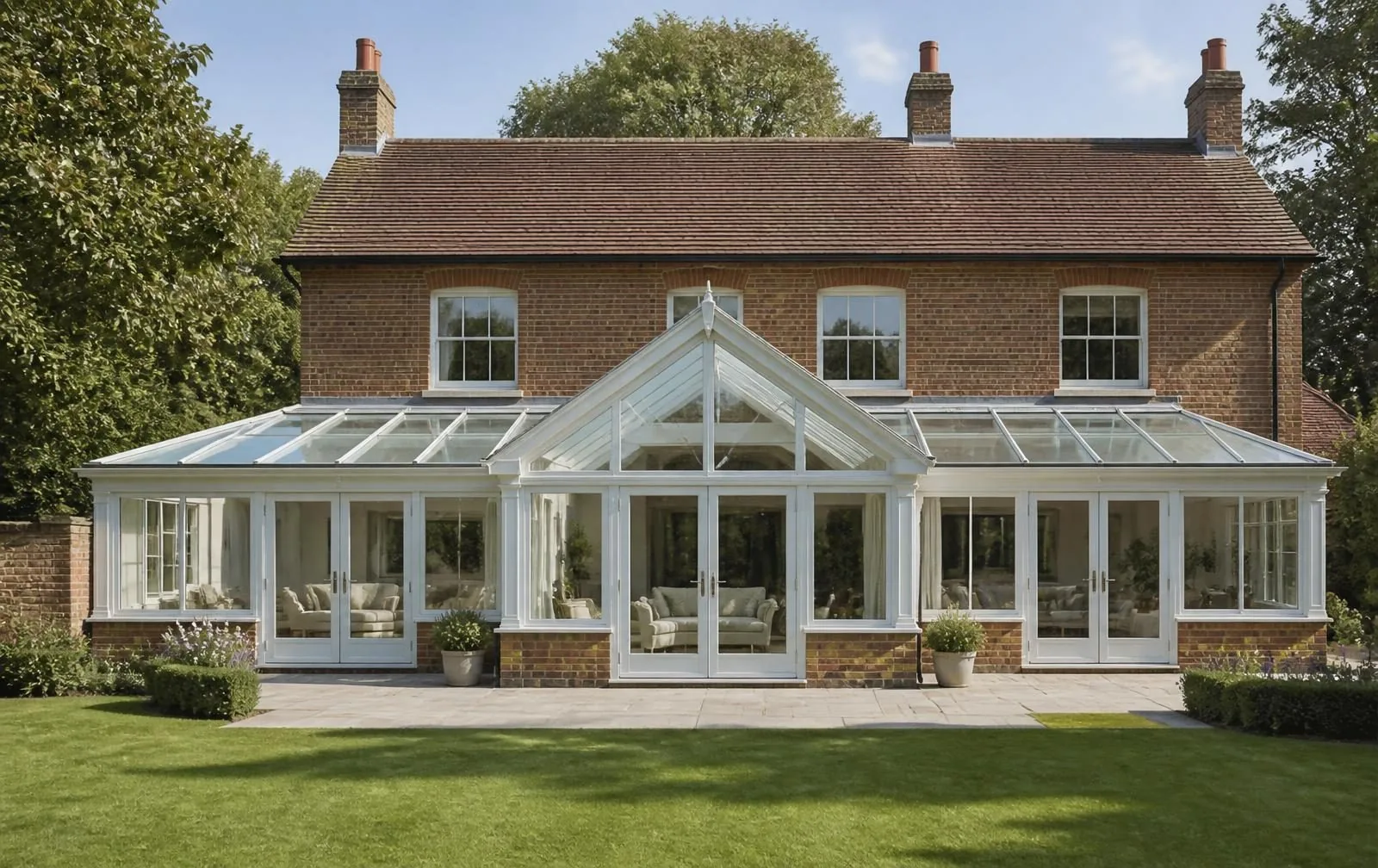
The gable conservatory keeps the front elevation upright rather than sloping into the roof, creating a tall, vertical wall of glazing. This gives the room a cathedral-like sense of volume and floods the space with light. It is often specified with a Georgian sunburst detail in the apex.
Gable conservatories suit larger properties and gardens where the conservatory is intended to be a landmark feature. They are less suitable for small plots or properties where the height would dominate the garden. The vertical front can also create more solar gain, so glazing specification is important.
P-shaped: two rooms in one
The P-shaped conservatory combines a Victorian or Edwardian projection with a lean-to run alongside, forming the shape of the letter P. This creates two distinct zones under one roof — perhaps a sunny garden lounge in the rounded bay and a dining area in the rectangular lean-to.
This style is best for larger detached and semi-detached homes with enough garden depth to accommodate the projection. It offers flexibility and drama, but it also costs more than a simple lean-to or Edwardian and needs careful proportioning to avoid looking unbalanced.
T-shaped: the grand family flagship
The T-shaped conservatory has a central projection that extends into the garden, flanked by two symmetrical wings running along the rear of the house. It creates a striking, symmetrical rear elevation and a very large usable footprint, ideal for open-plan kitchen-diner-living spaces.
This is the most expansive style and is only suitable for large detached homes with generous rear gardens. The cost and structural complexity are highest here, but the result can be a genuinely transformative family space.
Matching style to property type
For Victorian and Edwardian houses, a Victorian or Edwardian conservatory is usually the most sympathetic choice. For 1930s semis and post-war properties, an Edwardian or lean-to often works better. For bungalows and cottages with low eaves, a lean-to is usually the only practical option. For modern detached homes, gable, Edwardian or P-shaped conservatories can create a strong contemporary statement.
The garden also matters. A Victorian or P-shaped projection needs depth. A lean-to or Edwardian can work on a shallower plot. A T-shaped conservatory needs a large, level garden to look proportional.
Our view
Our view
If you want maximum practicality, an Edwardian conservatory is hard to beat. If you want period character, a Victorian is the obvious choice. For bungalows and restricted-height plots, a lean-to is almost always the right answer. For large homes where the conservatory is the main entertaining space, a P-shaped or T-shaped design is worth the extra investment. The key is to choose the style that fits your house, not the one you like most in isolation.
Frequently asked questions
Which conservatory style is most popular?+
The Edwardian and Victorian styles are the most popular in the UK. Edwardian is favoured for its rectangular floor plan and maximum usable space. Victorian is favoured for its elegant bay front and period character. Lean-to is the most popular for bungalows and smaller plots.
What is the best conservatory for a bungalow?+
A lean-to conservatory is usually the best choice for a bungalow because its single-pitch roof stays low and works well with restricted eaves height. It is also one of the most cost-effective styles.
Which conservatory gives the most space?+
The Edwardian conservatory gives the most usable floor space for a given footprint because it has a rectangular floor plan. The T-shaped conservatory gives the largest overall footprint and is ideal for large detached homes.
What is the most traditional-looking conservatory?+
The Victorian conservatory is the most traditional-looking, with its faceted bay front, steep pitched roof and decorative ridge cresting. It is the style most people picture when they think of a classic conservatory.
Can a modern house have a Victorian conservatory?+
Yes, but it needs to be handled carefully. A Victorian conservatory can look out of place on a very modern house unless the proportions, materials and colours are chosen to create a deliberate contrast rather than a mismatch. Many modern homes suit an Edwardian, lean-to or gable style better.
Which conservatory is best for a large family?+
A P-shaped or T-shaped conservatory is best for a large family because they provide two distinct zones or a very large open space. P-shaped combines a Victorian or Edwardian projection with a lean-to run. T-shaped has a central projection with two symmetrical wings.
What is the difference between a Victorian and Edwardian conservatory?+
A Victorian conservatory has a faceted bay front, usually three or five sides, and a steeply pitched roof with decorative detailing. An Edwardian conservatory has a flat front and a rectangular floor plan, making it more space-efficient and slightly more understated.
Does the style affect the cost?+
Yes. Simple rectangular styles like lean-to and Edwardian are usually cheaper because they are easier to manufacture and install. Victorian and gable styles cost more because of the roof complexity. P-shaped and T-shaped conservatories cost the most because they combine multiple roof forms.