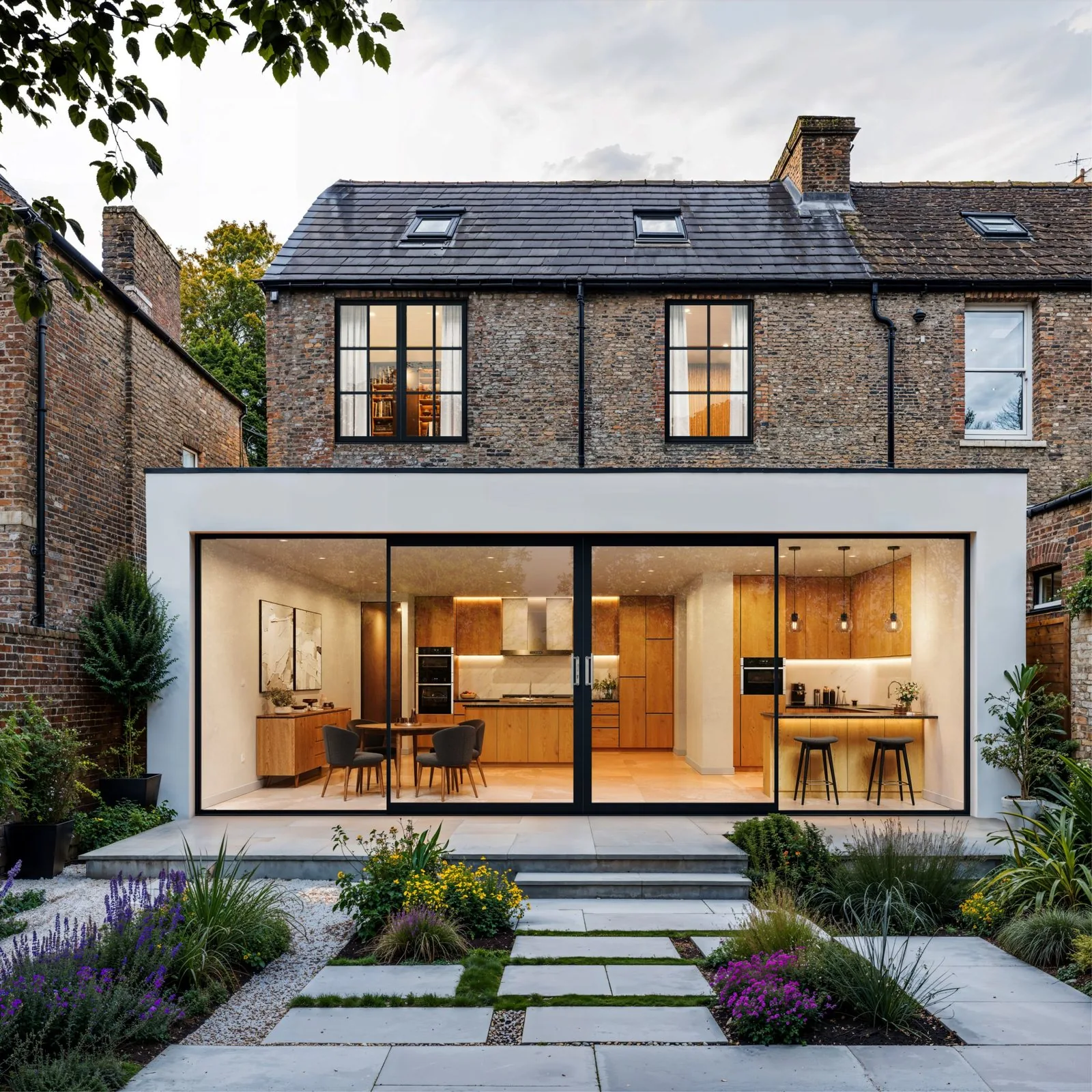
Slim-frame structural slider
The narrowest available sightlines, engineered to carry large panels with interlocks reduced to the minimum the hardware allows.
Doors / Patio / Aluminium
The material of choice where the opening is wide, the glass is heavy, and the sightline needs to stay narrow.
Introduction
Aluminium is chosen for patio doors principally for one reason: its strength to weight ratio allows a genuinely slim, structurally sound frame to carry panels far larger and heavier than an equivalent section in another material. That is why the widest openings, the tallest panels and the narrowest interlocks in the patio door category are almost always specified in aluminium.
The material's one inherent weakness — its high thermal conductivity — is resolved by a polyamide thermal break running through every profile, physically separating the inner and outer faces of the frame so heat cannot bridge directly across the metal. This is not an optional upgrade; it is a fundamental part of how a modern aluminium door is built.
This page covers the material specifically, independent of whether the door itself is an inline slider, a lift and slide or a panoramic system, all of which are commonly specified in aluminium for exactly the structural reasons set out above.
Beautiful homes begin with better advice.
A door is a decision about arrival, security and daylight. We would rather help you get it right than sell you the one with the best margin.
Who this suits
Aluminium suits any opening where the panel size or the overall span pushes beyond what a uPVC frame can comfortably carry without excessive frame depth, which in practice covers most patio doors wider than a standard two-panel domestic opening.
It suits contemporary and architect-designed extensions where a minimal sightline is a stated design requirement, since no other mainstream frame material achieves comparable structural strength at comparable slimness.
Where budget is the overriding constraint and the opening is modest, a well-specified uPVC frame will do the job perfectly well, and the extra cost of aluminium is harder to justify purely on performance grounds.
Design styles
The narrowest available sightlines, engineered to carry large panels with interlocks reduced to the minimum the hardware allows.
A more traditional, visibly deeper aluminium section for openings wanting a stronger frame presence on the elevation.
Different powder coated finishes internally and externally, keeping interior rooms light while presenting a bold colour outside.
Available configurations
Inline slider
Standard 2, 3 or 4-pane sliding arrangements carried on an aluminium frame for wider spans than uPVC allows.
Lift and slide
Aluminium's strength makes it the near-universal material choice for lift and slide mechanisms carrying the heaviest panels.
Fixed picture frame combinations
Sliding panels paired with a fixed aluminium picture window to extend the glazed width without adding moving parts.
Corner-opening aluminium doors
Structural aluminium posts capable of supporting a glazed corner where two sliding runs meet without a load-bearing column.
Materials
Polyamide isolators separating inner and outer frame faces, the standard construction for any aluminium patio door.
Frames manufactured from a high proportion of recycled aluminium stock, reducing embodied carbon without any change in performance.
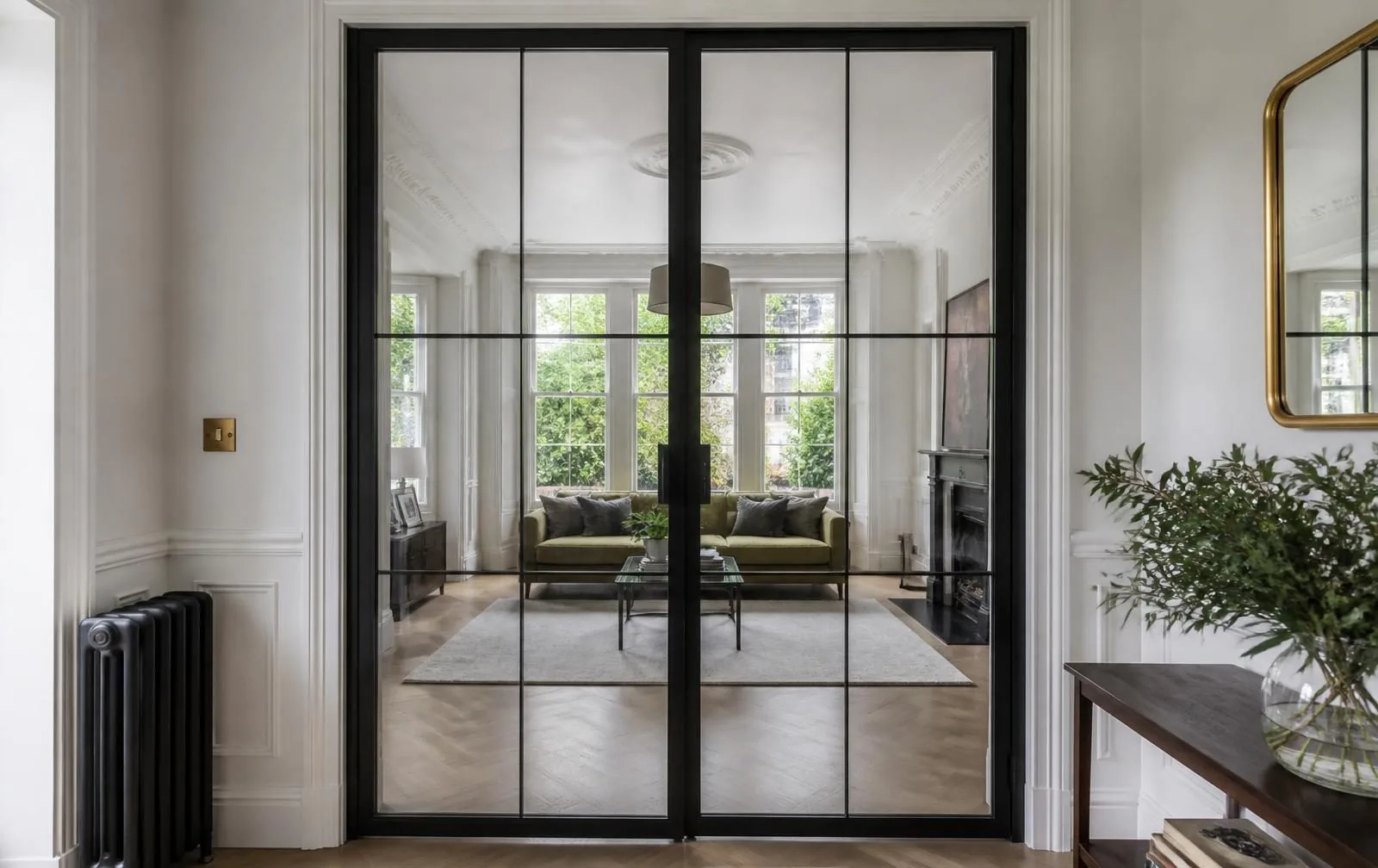
Narrow box profiles finished to resemble slender steel framing, popular on industrial-influenced extensions.
Colours & handles
Anthracite grey (RAL 7016)
The most requested aluminium finish, textured or matt, suiting render, brick and timber cladding alike.
Matt black
A strong architectural statement, particularly effective against light render or white internal decor.
Any RAL or bespoke colour
Powder coating gives access to the full RAL palette, including metallic and dual-tone finishes.
Flush pull handle
Recessed into the frame for an uninterrupted closed sightline, standard on slim-frame slider specifications.
Slimline lever handle
A low-profile lever suited to hinged access doors within a wider sliding arrangement.
Multi-point cylinder handle
Engages hook locking into the frame, tested as part of the overall PAS 24 hardware set.
Threshold options
Aluminium's strength allows a shallow, reinforced threshold profile without compromising the frame's structural integrity.
A deeper upstand for maximum weather resistance on exposed or elevated openings.
Glazing options
Standard specification suiting most domestic openings and budgets.
Aluminium's load capacity accommodates the extra pane and weight without additional frame reinforcement in most cases.
Larger, thicker panes supported directly by the aluminium frame with minimal visible glazing bead.
Coated and laminated options addressing heat gain and noise without altering the frame specification.
Security
Aluminium's structural rigidity means the frame itself resists distortion under forced entry attempts far better than a softer material, complementing the locking hardware rather than replacing it.
Thermal performance
Thermal performance in an aluminium door depends almost entirely on the quality of the polyamide thermal break, which is worth asking about specifically rather than assuming.
Weather resistance
Aluminium's dimensional stability across temperature swings means seals maintain consistent compression over years of use, a genuine advantage over materials that expand and contract more with heat.
Maintenance
Aluminium is among the lowest maintenance frame materials available, requiring no repainting or sealing under normal conditions.
Frequently asked questions
Aluminium has a far higher strength to weight ratio than uPVC, so a structural section can be made slimmer while still carrying the same or greater glass load. That is what allows aluminium patio doors to span wider openings and larger individual panels with a narrower visible frame than an equivalent uPVC system.
Yes. Aluminium is a natural conductor of heat, so without a thermal break — a strip of low-conductivity polyamide separating the inner and outer faces of the frame — it would form a significant cold bridge. Every aluminium patio door worth specifying uses a polyamide thermal break, and this is the single detail to confirm before anything else on a quotation.
Powder coating applies an electrostatically charged pigment that is then cured under heat into a durable, opaque colour finish available in any RAL shade. Anodising is an electrochemical process that thickens the aluminium's natural oxide layer, giving a metallic, slightly translucent finish rather than a flat colour. Powder coating is far more common for coloured domestic frames because of its colour range and consistency.
Premium slim-frame aluminium systems achieve interlocks of around 100 to 120mm, considerably narrower than most uPVC equivalents. This is a genuine structural achievement rather than a cosmetic trim, since the interlock still has to house dual gaskets and hook locking hardware within that reduced width.
Aluminium frames themselves are not the primary route for noise transmission, which is dominated by the glass specification and the seal quality rather than the frame material. A well-sealed aluminium door with acoustic laminated glass performs comparably to any other well-built frame material for noise reduction.
A correctly polyester powder coated aluminium frame, finished to the Qualicoat standard, typically carries a manufacturer's guarantee of 20 to 25 years against fading, chalking or peeling and does not require repainting under normal conditions. Coastal or heavily polluted environments may need periodic washing to maintain the finish.
Aluminium typically costs more than uPVC for an equivalent size, reflecting the material cost, the more complex thermal break construction and the narrower, more engineered sightlines. The premium is generally most justified on wider openings, heavier glass or where a minimal sightline is a firm design requirement.
Related articles
Begin the conversation
A consultation is a conversation about how you actually use the opening — where the sun falls, how the rain drives, who needs level access and what the street expects to see. You will receive a written specification you can understand and compare, and no follow-up pressure of any kind.
Systems & Profiles We Manufacture
We design and fabricate using premium window and door systems from the UK and Europe's leading manufacturers — so every installation is built on proven, fully warrantied profiles.