
Patio doors and bi-fold doors are both routes to a large glazed opening onto a garden, and both are frequently marketed on the drama of the fully open position, which can obscure the more important question of how the door will actually be used day to day.
This guide compares the two systems on opening width, sightlines, everyday convenience and cost, so you can match the mechanism to how the room genuinely functions.
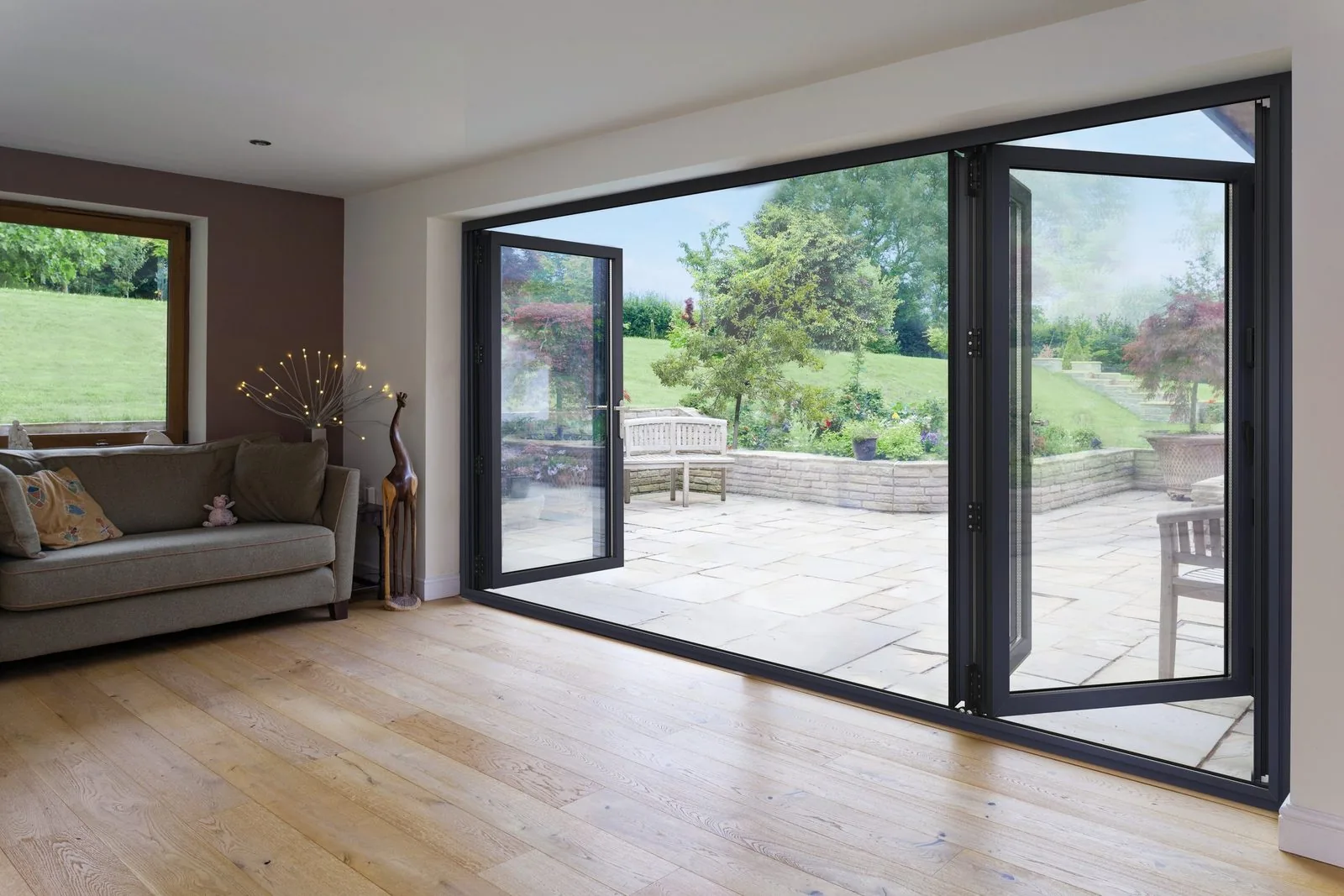
The fundamental difference
Patio doors slide horizontally on a track, with at least one panel remaining fixed while the others glide past it, meaning the maximum opening is always less than the full width of the frame. Bi-fold doors fold each panel back against its neighbour and stack the whole set to one or both sides, meaning the entire opening can become clear space.
That single structural difference is the source of almost every other trade-off between the two systems — cost, sightlines, everyday convenience and how each performs when only partially open.
Opening width and architectural drama
If the goal is to remove the boundary between an interior room and the garden entirely — for entertaining, for a summer party, or simply for the sensation of a wall disappearing — bi-fold doors deliver that in a way sliding doors cannot, since even a large patio door leaves roughly half its width permanently glazed and fixed.
Where the ambition is more modest — a wide, glazed opening that occasionally opens fully but is more often used as a large window with a walk-through section — sliding patio doors achieve that with fewer moving parts and, in many cases, a cleaner uninterrupted view when closed.
| Factor | Patio (sliding) | Bi-fold |
|---|---|---|
| Maximum clear opening | Roughly half the total width | Up to the full width |
| Sightlines when closed | Fewer frame lines, larger panes | More frame lines between panels |
| Typical cost | Lower | Higher |
| Everyday use | Quick, single action | Requires folding each panel |
| Best suited to | Wide fixed views, moderate ventilation | Full-width entertaining openings |
Everyday use versus occasional use
It is worth being realistic about how often a door will actually be opened fully. Many households open a bi-fold's full run only a handful of times a year — for a barbecue, a family gathering, or a genuinely hot week — and use a single traffic door panel for daily access the rest of the time. If that describes your household, a well-configured bi-fold with a traffic door gives you both convenience and drama on the days it matters.
If daily, quick access and an uninterrupted view are the priority, and the full-width opening is a nice-to-have rather than a requirement, a sliding patio door is often the more practical specification, and the cost saving can be put towards a larger overall opening or better glazing specification instead.
Sightlines and the view when closed
For most of the year, both types of door spend the majority of their time closed, which makes the view through the glass, not the maximum opening width, the more relevant everyday consideration for many households. A sliding patio door with slim interlocks and large panes typically offers a cleaner, less interrupted view than a bi-fold's necessarily more frequent frame lines.
Cost and installation considerations
Bi-fold doors cost more than an equivalent-width sliding patio door, reflecting the additional hinges, panels and running gear required, and they also typically require a slightly larger structural opening to accommodate the stacked panels at one or both ends. Patio doors are the more cost-effective route to a wide glazed opening where the full-width opening capability is not essential.
Our view
Our view
For rooms used for regular entertaining, or where removing the wall entirely is a stated part of the design brief, bi-fold doors with a traffic door panel deliver the best of both full-width drama and everyday convenience. For rooms where the view matters more than the full-width opening, or where budget is a firm constraint, sliding patio doors offer better value and often a cleaner view when closed.
We would encourage clients to be honest about how many times a year they expect to open a door fully, since that single answer usually settles the decision.
Frequently asked questions
Which is cheaper, patio doors or bi-fold doors?+
Sliding patio doors are typically less expensive than bi-fold doors for an equivalent opening width, largely because they involve fewer panels, fewer hinges and simpler running gear.
Which gives a bigger opening, patio or bi-fold?+
Bi-fold doors can open the entire width of the opening, since every panel stacks aside, whereas a sliding patio door only ever opens roughly half its total width because one or more panels remain fixed in place.
Do bi-fold doors let in less light when closed?+
Slightly, yes — bi-fold doors have more frame per square metre of opening because of the additional hinges and stiles between panels, so a patio door with the same overall width typically has a larger uninterrupted glass area when both are closed.
Which is better for a room used daily rather than for entertaining?+
Patio doors, generally. Opening a two or three panel slider for everyday ventilation is quicker and requires no folding action, whereas a bi-fold's full-width opening is most valuable on the occasions you genuinely want the wall gone, such as entertaining or hot weather.
Do bi-fold doors need more maintenance than patio doors?+
Bi-fold doors have more moving parts — multiple hinge sets and a roller per panel — so there is marginally more hardware to keep clean and lubricated, though neither system is high maintenance when specified with quality running gear.
Can I have a bi-fold door with one panel that opens independently as a normal door?+
Yes, this is called a traffic door and is a very common configuration, allowing everyday access without opening the full run of panels, and is worth specifying on any bi-fold used for daily access rather than only in summer.
Which is better for a narrow opening?+
Sliding patio doors generally suit narrow openings better, since bi-fold panels need to stack somewhere and a very narrow opening leaves little room for the stacked panels without eating into the usable glazed width.
Products discussed