
Rooflights come in several forms, and the difference between them is not just aesthetic. A roof lantern, a flat rooflight and a fixed panel perform differently in terms of light distribution, thermal efficiency, ventilation and cost. The right choice depends on the room below, the roof structure, the style of the house, and what you want the rooflight to contribute to the space.
This guide compares the main types of rooflight and explains the situations where each one is the best fit.
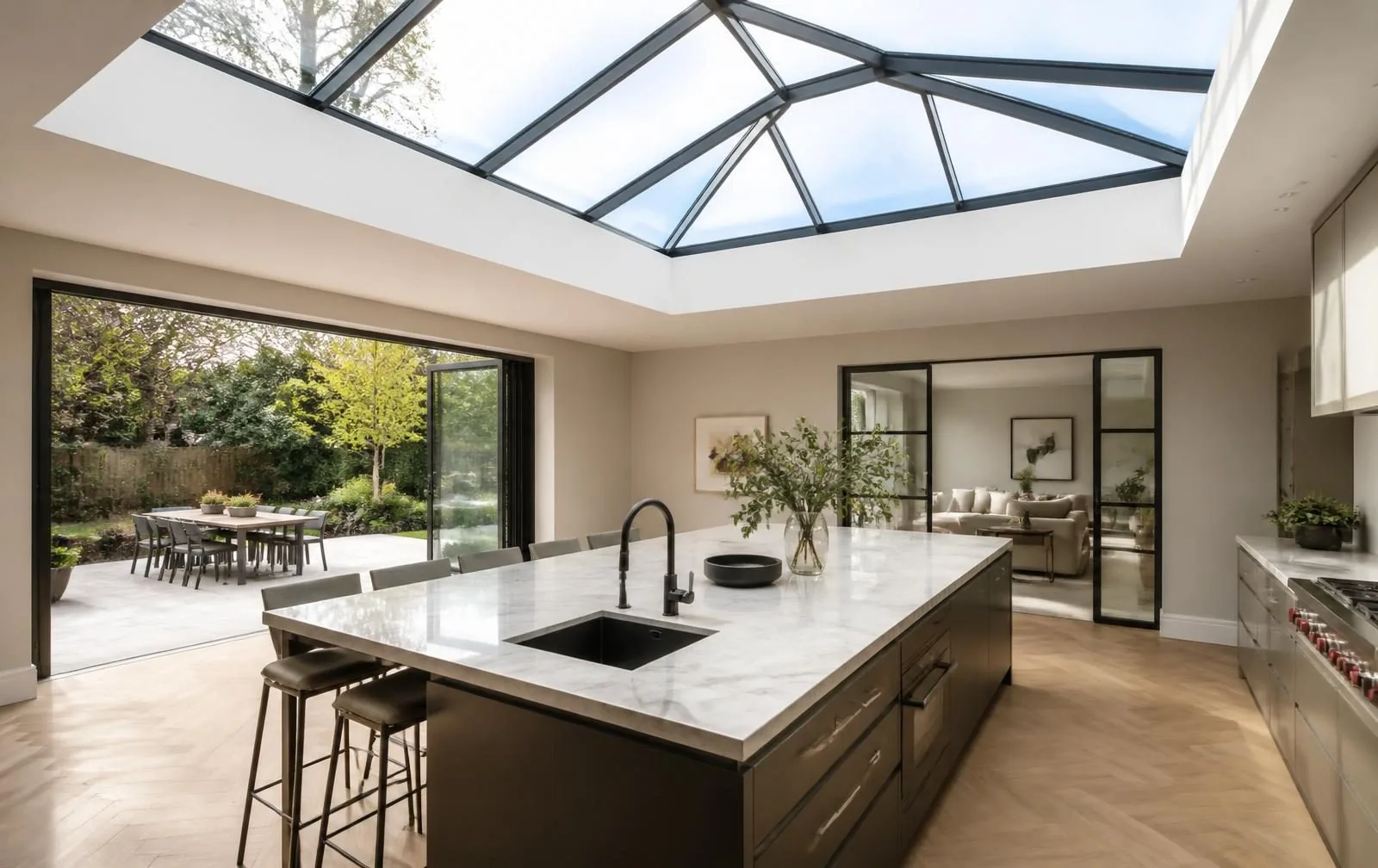
Roof lanterns: light and architecture
A roof lantern is a raised structure that sits on a flat roof and has glazed sides as well as a glazed top. Because the sides catch light from lower angles, lanterns can bring daylight into a room earlier in the morning and later in the afternoon than a flat rooflight of the same footprint. They also create a three-dimensional ceiling feature inside the room, which can give a sense of height and occasion.
Roof lanterns are the most visually assertive option. From the garden, they read as a proper roof feature rather than a thin line of glass. That makes them a good choice for traditional properties, for extensions where the rooflight is intended to be a focal point, and for rooms that benefit from a strong ceiling feature. The trade-off is that they are more expensive and may be more visible to neighbours and planners.
Flat rooflights: minimal and modern
Flat rooflights are low-profile glazed panels that sit close to the surface of the roof. They are designed to be unobtrusive, both from the outside and from inside. The best flat rooflights have minimal frames and large glass areas, sometimes appearing almost frameless from below.
This type of rooflight is ideal for modern extensions, minimalist kitchens, and any project where the architecture should not be interrupted by a bulky roof feature. Flat rooflights are also usually easier and cheaper to install than lanterns, and they tend to be more thermally efficient because the glazing area is closer to the roof insulation.
Fixed rooflights: simple and efficient
Fixed rooflights do not open. They are designed purely for daylight and for views of the sky. Because they have no moving parts, they are the most thermally efficient and the lowest-maintenance option. They are also usually the cheapest.
The obvious limitation is ventilation. If the room below needs to be able to purge hot air, a fixed rooflight is not enough on its own. It can be paired with opening windows, extract ventilation, or a separate opening rooflight. In many rooms, however, the daylight contribution is the priority and a fixed rooflight is the sensible choice.
Opening rooflights: ventilation and access
Opening rooflights can be manually or electrically operated. They provide ventilation, which is valuable in kitchens, bathrooms and any room prone to overheating. Some electric opening rooflights can be linked to rain sensors so they close automatically if the weather changes.
The trade-off is cost, complexity and a slight reduction in thermal performance compared with fixed units. Opening rooflights also need careful detailing around the opening mechanism to ensure long-term weather resistance. For rooms that need natural ventilation, they are often worth the extra cost.
Which rooflight is right for your project?
Choose a roof lantern if you want maximum light, a strong ceiling feature, and a design that works well on traditional or statement extensions. Choose a flat rooflight if you want a minimalist look and the best thermal performance for a modern extension. Choose a fixed rooflight if daylight is the priority and ventilation is handled elsewhere. Choose an opening rooflight if the room needs natural ventilation.
In many projects, a combination works best: a large flat fixed rooflight over the main living area for daylight, and a smaller opening rooflight over the kitchen for ventilation. The important thing is to match the type to the room's needs, not just the roof's shape.
| Type | Light | Look | Cost | Best for |
|---|---|---|---|---|
| Roof lantern | Excellent | Traditional / feature | Higher | Period properties and statement rooms |
| Flat rooflight | Very good | Minimal / modern | Mid | Contemporary extensions and clean ceilings |
| Fixed rooflight | Very good | Minimal | Lower | Daylight where ventilation is elsewhere |
| Opening rooflight | Good | Minimal | Higher | Ventilation in kitchens and bathrooms |
Our view
Our view
For most modern extensions, we tend to recommend flat fixed rooflights for their clean look and thermal performance, with opening units added where ventilation is needed. For traditional properties or rooms where the rooflight should be a ceiling feature, a roof lantern is usually the better choice. The key is to decide what the rooflight needs to do for the room before choosing the form.
Frequently asked questions
What is the difference between a roof lantern and a flat rooflight?+
A roof lantern is a raised structure on a flat roof with glazed sides, creating a three-dimensional light source. A flat rooflight is a low-profile glazed panel that sits close to the roof surface, giving a more minimalist appearance.
Which rooflight brings in the most light?+
Roof lanterns generally bring in the most light because the glazed sides catch light from lower angles earlier and later in the day. Flat rooflights are more dependent on direct overhead light, but they can still flood a room with daylight in the middle of the day.
Are fixed rooflights cheaper than opening rooflights?+
Yes. Fixed rooflights are simpler because they have no opening mechanism, no hinges and no seals to maintain. They are cheaper to buy and install, and they are usually more thermally efficient than opening units because there are fewer moving parts.
Can I have a rooflight on any flat roof?+
Most flat roofs can accommodate a rooflight, but the structure must be checked. A roof lantern needs a kerb or upstand to sit on, and the roof must be able to support the weight. A flat rooflight can often be fitted within the existing roof build-up if the structure is suitable.
Do roof lanterns need planning permission?+
Often no, if they are within permitted development limits. However, conservation areas, listed buildings and Article 4 directions may restrict the size, height and design. It is always worth checking the planning position before ordering.
Which rooflight is best for a modern extension?+
Flat rooflights and minimalist frameless rooflights are usually the best fit for modern extensions because they sit flush with the roof and do not interrupt the clean lines. Contemporary roof lanterns with slim frames can also work well as a deliberate feature.
Can a rooflight be too big?+
Yes. A very large rooflight can overheat the room below in summer and lose too much heat in winter. It can also dominate the roof externally. The right size balances the daylight gain with the thermal performance and the external appearance of the roof.
Products discussed