
Almost every window quote in the UK now arrives with an energy rating letter somewhere on the page, usually A++ or A. It's a genuinely useful shorthand, but it's also a composite score built from three separate measurements, and relying on the letter alone can mask real differences between two specifications that carry the same grade.
This guide sets out what a Window Energy Rating actually measures, how it relates to U-value, g-value and Building Regulations compliance, and what to ask for on a quote so you're comparing genuinely equivalent numbers rather than marketing shorthand.
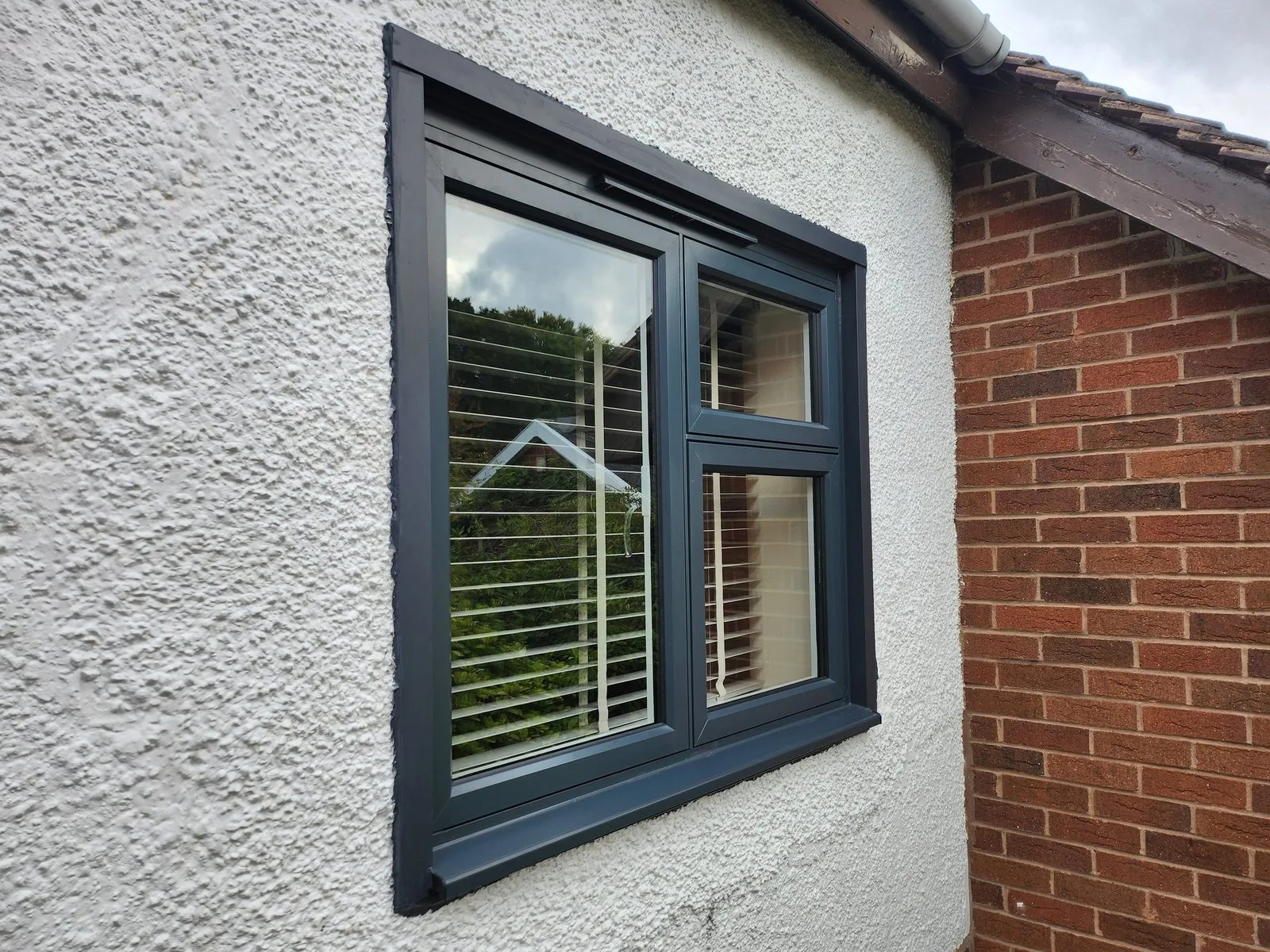
What a Window Energy Rating actually measures
A Window Energy Rating (WER) is a single letter grade, from A++ down to E, issued by the British Fenestration Rating Council (BFRC). It is designed to give homeowners a quick, comparable summary of how a whole window performs thermally, rather than requiring them to interpret raw technical figures. The rating is calculated from three underlying measurements combined into an energy index: the U-value (heat lost through conduction), the g-value (solar heat gained through the glass), and air leakage (heat lost through gaps around the sash).
The important thing to understand is that the letter is a composite score, not a direct measurement of any single property. Two windows can both carry a B rating while having meaningfully different U-values and g-values, because a stronger score in one area can offset a weaker score in another. That's why we always ask to see the underlying numbers behind a quoted rating, rather than treating the letter as the whole story.
WER versus U-value: two different questions
A U-value measures the rate of heat transfer through a material, expressed in watts per square metre per kelvin (W/m²K) — the lower the number, the better the material is at retaining heat. It answers one specific question: how much heat escapes through this window when it's cold outside? A WER letter answers a broader question: accounting for heat loss, solar gain and draughts together, how energy-efficient is this window overall, in typical UK conditions?
This distinction matters most on south-facing elevations, where a window that scores well on WER because of generous solar gain might have a U-value that looks less impressive in isolation — and the reverse is also true on north-facing elevations, where solar gain contributes little and a low U-value does almost all of the useful work. If you're specifying room-by-room rather than accepting a single house-wide standard, the U-value and g-value are more useful individually than the combined letter.
| Metric | What it measures | Where to see it |
|---|---|---|
| WER (A++ to E) | Combined thermal efficiency: U-value, g-value, air leakage | BFRC-certified product datasheet |
| U-value (W/m²K) | Conducted heat loss through the window | Manufacturer's technical data / NFRC or BS EN 10077 test |
| g-value (0–1) | Proportion of solar energy transmitted through the glass | Glass manufacturer's specification |
| Air permeability | Draughts around the sash and frame junctions | Test certificate to BS 6375 |
Whole-window U-value versus centre-pane U-value
Glass manufacturers often quote a centre-pane U-value, which measures heat loss through the middle of the glazed unit only, away from the spacer bar and frame. It's a genuine figure, but it's also the best-case number a window can produce, because it excludes the two places where heat escapes fastest: the metal or foam spacer bar at the edge of the glass, and the frame itself.
Whole-window U-value, calculated to BS EN ISO 10077-1, factors in the frame profile, the spacer, and the proportion of glass to frame across a standard reference window size. It is almost always a higher (worse) figure than centre-pane — often by 15 to 25 percent — and it is the figure that actually determines a room's comfort and a property's Building Regulations compliance. When a quote only states a centre-pane figure, ask for the whole-window equivalent before comparing it against another supplier's number.
- Centre-pane U-value: best-case, glass-only figure — useful for comparing glass units, not whole windows
- Whole-window U-value: includes frame and spacer, and is what Building Regulations actually assess
- A narrow-sightline aluminium frame with a poor thermal break can lose the advantage a good glass unit gives it
- Always ask which figure is on the quote before comparing two suppliers' numbers
G-value and the trade-off with solar gain
The g-value, sometimes called the solar factor, describes what fraction of incoming solar energy passes through the glass into the room, on a scale from 0 to 1. A high g-value (around 0.6–0.7) lets in a large proportion of free solar warmth, which is genuinely useful on a south-facing living room in winter. A low g-value (around 0.3–0.4), often achieved with a solar-control coating, blocks more of that heat, which is preferable on a west-facing conservatory-style extension prone to summer overheating.
There is no universally correct g-value — it depends entirely on orientation, room use and overheating risk. A specification team should be asking about your elevation's compass direction and how the room is used before recommending a coating, not applying the same glass specification to every window in the house regardless of aspect.
Part L compliance and what it means in practice
Approved Document L of the Building Regulations sets minimum thermal performance for replacement windows in existing English dwellings, currently a backstop whole-window U-value of 1.4 W/m²K, with FENSA- or CERTASS-registered installers able to self-certify compliance without a separate Building Control application. Scotland and Wales operate their own equivalent standards under their respective building standards systems, with broadly similar targets.
Meeting the backstop is a legal minimum, not a specification target. Most modern double-glazed units with a low-E coating, argon fill and warm-edge spacer will comfortably clear 1.4 W/m²K and land closer to 1.2–1.3 W/m²K whole-window, which is worth bearing in mind if a quote presents 'Part L compliant' as though it were a premium feature rather than the baseline it actually is.
What to check on a window quote
Given how much the same letter or headline figure can hide, it's worth asking every supplier for the same three numbers on a like-for-like basis: whole-window U-value (not centre-pane), g-value for the specific glass specification quoted, and the air permeability test class. If a supplier can't produce these on request, that's usually a sign the specification hasn't been tested to the standard it's being marketed against.
It's also worth asking whether the WER letter quoted relates to the exact frame and glass combination in your quote, or to a reference configuration from the manufacturer's brochure — the two can differ meaningfully once you add features such as Georgian bars, larger sightlines, or a non-standard colour.
Our view
Our view
The WER letter is a reasonable starting filter, but we always work from the underlying whole-window U-value, g-value and air permeability figures when specifying, because they answer more specific questions about how a window will actually behave on your elevation.
If a supplier can quote you a rating letter but can't produce the whole-window U-value behind it, treat that as a gap in the specification worth pressing on before you commit.
Frequently asked questions
What does an A++ window energy rating actually mean?+
It's a single letter grade (A++ to E) produced by the British Fenestration Rating Council, combining a window's U-value, solar heat gain (g-value) and air leakage into one index score. A++ is the highest band currently issued, but the letter alone doesn't tell you the U-value, so it's worth asking for the underlying figures.
Is a lower U-value always better?+
For heat retention, yes — a lower U-value means less heat escapes through the window. But U-value only measures conducted heat loss; it says nothing about solar gain, so a window optimised purely for a low U-value can sometimes let in less useful winter sunlight than one with a slightly higher U-value and a well-chosen g-value.
What's the difference between centre-pane and whole-window U-value?+
Centre-pane U-value measures only the glass in the middle of the unit, ignoring the spacer bar and frame. Whole-window U-value, calculated to BS EN ISO 10077, accounts for the frame and edge effects too, and is typically 15-25% higher (worse) than the centre-pane figure quoted in marketing material.
Does Building Regulations Part L require a specific U-value?+
Yes. Approved Document L sets a backstop whole-window U-value of 1.4 W/m²K for replacement windows in existing dwellings in England, with a notional target closer to 1.2 W/m²K where possible. Installers registered with a competent person scheme, such as FENSA or CERTASS, must self-certify compliance.
What is g-value and why does it matter?+
G-value (or solar factor) measures the proportion of solar energy that passes through the glass into the room, expressed from 0 to 1. A high g-value lets in more free winter warmth but risks summer overheating on south-facing glazing; a low g-value keeps rooms cooler in summer but sacrifices some passive solar gain in winter.
Can two windows with the same U-value perform differently?+
Yes. U-value alone doesn't capture solar gain, air permeability or how well the frame resists thermal bridging at the edges. Two windows can share an identical U-value on paper and still behave differently in a real room depending on their g-value and how the frame is detailed.
Do window energy ratings affect my EPC?+
They contribute to it. The Standard Assessment Procedure used for Energy Performance Certificates factors in window U-values and areas, so upgrading from single glazing or old double glazing to modern low-E units with a good whole-window U-value can measurably improve an EPC band.
Should I choose windows based on the rating letter alone?+
No — treat the letter as a starting filter, then ask for the whole-window U-value, g-value and air permeability figures behind it. A specification with a slightly lower letter but a genuinely better whole-window U-value, correctly detailed for your elevation, is often the smarter choice.
Products discussed