
The decision between a conservatory and an orangery is often presented as a style choice, but it is really a choice about how the room will perform. A conservatory is a glass structure with a glass roof. An orangery is a more solid room with a central lantern. That difference affects everything: cost, warmth, light, noise, how the room connects to the house, and how it is perceived by buyers.
This guide explains the technical distinction, the practical differences, and the situations where one makes more sense than the other.
The technical difference
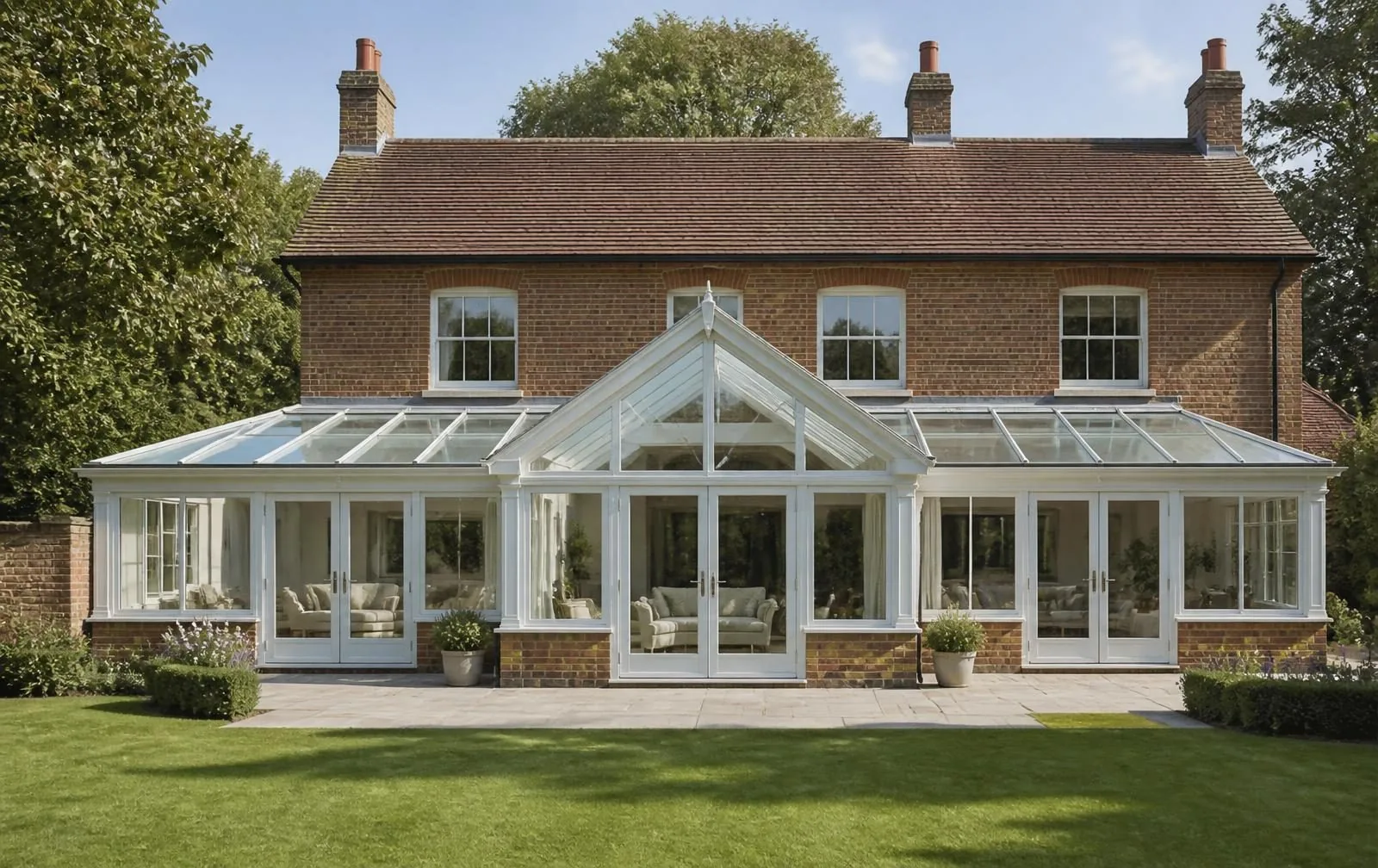
The official difference between a conservatory and an orangery is defined by Building Regulations guidance. A conservatory has a roof that is at least 75 percent glazed, and walls that are at least 50 percent glazed. An orangery has a solid roof, usually with a central glazed lantern, and more solid wall area, often with brick or stone pillars and an internal plastered ceiling.
In practice, that technical difference translates into a very different feel. A conservatory is a light-filled, glass structure that sits between the house and the garden. An orangery is a more substantial room that happens to have a lot of glass, and it usually feels more like a permanent extension of the house than a separate garden room.
Cost comparison
An orangery is almost always more expensive than a conservatory of the same footprint. The extra cost comes from the additional brickwork, the solid roof structure, the lantern, the internal plastering, and the more substantial foundations and structural connections. The premium is typically 30 to 60 percent over a comparable conservatory.
However, the extra cost buys a room that is closer to a full extension in performance and value. An orangery is likely to be warmer, quieter, more flexible in use and more attractive to future buyers. For homeowners who want a genuine year-round living space, the additional investment often makes sense.
Thermal performance and year-round use
Because an orangery has more solid wall and roof area, it is easier to insulate to the same standard as the rest of the house. The central lantern provides light without the thermal penalty of a fully glazed roof. As a result, an orangery is usually much easier to keep warm in winter and cool in summer than a conservatory.
A conservatory with a warm roof can close much of this gap. A high-performance glass roof with solar-control and low-E coatings can also make a conservatory comfortable for most of the year. But the starting point is different: an orangery is designed as a room, while a conservatory is designed as a glazed addition and needs more help to perform like one.
Aesthetic impact and integration
A conservatory is generally lighter and more transparent, making it ideal for garden rooms, dining areas and spaces where the view of the garden is the main feature. An orangery is more solid and grounded, which can look more appropriate on a period property or in a setting where a fully glazed box would feel out of place.
An orangery also integrates better with open-plan layouts. Because it is built to extension standards, removing the internal wall and creating a seamless kitchen-diner-living space is often more straightforward. A conservatory can also be open-plan, but it may require more work to satisfy Building Regulations and thermal bridging requirements.
Which one suits your project?
Choose a conservatory if you want maximum light, the strongest garden connection, and a lower cost per square metre. Choose an orangery if you want a room that feels like a permanent extension, performs well year-round, and integrates seamlessly with the rest of the house.
If you are unsure, a good test is to ask what you will do in the room on a cold January evening. If the answer is 'put the heating on and use it like any other room', an orangery is probably better. If the answer is 'wrap up and enjoy the garden view', a conservatory with a good roof may be perfect.
Hybrid options: the best of both
Many modern extensions blur the line between conservatory and orangery. A lean-to conservatory with a solid warm roof and large glazed panels, or a garden room with full-height glazing and a plastered ceiling, can deliver the light of a conservatory with the performance of an orangery. These hybrid designs are increasingly popular because they avoid the either-or choice.
The key is to be honest about what you want from the space and to design the structure around that, rather than picking a label first. The words 'conservatory' and 'orangery' are useful shorthand, but the actual building can be tuned along a spectrum between the two.
Our view
Our view
There is no single winner. A conservatory is the right choice when the priority is light, garden connection and cost. An orangery is the right choice when the priority is a year-round room that feels like a proper extension. For many homeowners, a hybrid design — a garden room with a warm roof and large glazed panels — gives the best of both. The important thing is to decide what the room needs to do before choosing the label.
Frequently asked questions
What is the difference between a conservatory and an orangery?+
A conservatory has a roof that is at least 75 percent glazed and walls that are at least 50 percent glazed. An orangery has a solid roof with a central glazed lantern and more solid wall area, making it feel closer to a proper extension.
Is an orangery more expensive than a conservatory?+
Yes, usually by 30 to 60 percent. An orangery uses more brickwork, solid roofing and structural elements, and is often more heavily integrated with the house. The extra cost buys better thermal performance and a more permanent feel.
Does an orangery need planning permission?+
Like a conservatory, an orangery may fall under permitted development if it meets the same size and height limits. However, because it looks more like a permanent extension, it is sometimes more carefully scrutinised in conservation areas or on sensitive sites.
Which is warmer, a conservatory or an orangery?+
An orangery is generally warmer because it has more solid walls and a solid roof, usually with a central lantern rather than a fully glazed roof. That solid structure is easier to insulate to the standard of the rest of the house.
Can an orangery be open plan to the house?+
Yes, and this is one of its main advantages. Because an orangery is built to closer extension standards, it is more likely to be accepted as open-plan with the kitchen or living room, subject to Building Regulations approval.
Which is better for a period property?+
An orangery often looks more sympathetic on a period property because it reads as a masonry extension rather than a glazed box. That said, a well-designed timber or heritage-style conservatory can also work beautifully on the right house.
Does a conservatory add more light than an orangery?+
Yes, because it has more glass in the roof and walls. If the priority is a bright, garden-connected room, a conservatory is usually better. If the priority is a cosy, year-round room, an orangery is usually better.
Can I turn a conservatory into an orangery later?+
You can replace the roof and add more solid wall, but the footprint and structural constraints are fixed by the original design. It is usually cheaper and more effective to decide between the two at the start rather than retrofitting one into the other.