
Introduction
Composite doors have become the default choice for front doors on much of the UK's new and replacement housing stock, and for good reason: they combine a solid, insulated core with a durable glass-reinforced plastic, or GRP, outer skin that resists the warping, cracking and fading that affected many timber and early uPVC doors before them. That durability has, understandably, led to an assumption that composite doors are essentially maintenance-free, which is not quite accurate.
The core structure of a composite door is genuinely very stable, and the material itself will not rot, swell or need repainting in the way a timber door does. What does need occasional attention is everything that makes the door actually function as a door: the hinges that carry its considerable weight, the multi-point locking mechanism that secures it at several points around the frame, the cylinder the key turns in, and the seals and threshold that keep weather out. These are mechanical and rubber components living inside or attached to a very durable shell, and they age and wear at their own pace, regardless of how good the GRP skin still looks.
This guide sets out the specific maintenance tasks that keep a composite door performing as it should, in roughly the order homeowners tend to notice a problem: cleaning the skin, understanding summer bowing in dark colours, adjusting hinges properly, looking after the locking mechanism and cylinder, and managing the threshold and seals that quietly do most of the weatherproofing work.
Quick summary
The short version
- Clean the GRP skin with warm water and mild detergent only — avoid abrasive pads and solvent-based cleaners, which dull the moulded woodgrain finish.
- Dark-coloured composite doors can bow very slightly in strong summer heat, causing temporary sticking that eases as the door cools.
- Have hinges checked roughly annually. Composite doors are heavy, and hinges set in three planes need periodic fine adjustment as they settle.
- Always lift the handle fully before turning the key. This drives the multi-point locking bolts home before the key throws the deadbolt.
- Lubricate the cylinder with graphite or PTFE-based lubricant, not oil, and consider a snap-secure cylinder upgrade if your door predates roughly 2015.
- Keep the threshold's drainage channels clear and check seals seasonally, since worn seals are the most common cause of draughts on an otherwise sound door.
Why this matters
A composite door typically weighs considerably more than a uPVC or softwood equivalent, often 30 to 40 kilograms once glazing and hardware are accounted for, because of its dense insulated core and solid engineered timber sub-frame beneath the GRP skin. That weight is part of what gives it its reassuring, solid feel when it closes, but it also means the hinges, hanging stile and locking keeps are under continuous, significant load in a way a lighter door is not, and small amounts of settlement or wear are normal over time rather than a sign of a faulty product.
The multi-point locking mechanism is doing more work than a traditional single lock ever did, engaging hookbolts, deadbolts and sometimes rollers into keeps at several points up and down the frame simultaneously. This gives excellent security when everything is correctly aligned, but it also means the mechanism is less forgiving of a door that has dropped even a few millimetres out of true, since a bolt that no longer lines up precisely with its keep will strain every time it is forced home, accelerating wear on both the mechanism and the keep itself.
None of this maintenance is difficult or expensive when caught early. A hinge adjustment is typically a five-minute job with an Allen key. Left unaddressed for years, the same misalignment can wear a locking mechanism to the point of replacement, or cause a door to bind against its frame badly enough to affect the weatherseal and let in draughts. The theme running through composite door care, much like other products in this range, is that small, regular attention avoids larger, costlier problems later.
- Composite doors typically weigh 30–40kg fully glazed, placing continuous load on hinges and locking keeps
- Multi-point locks engage several bolts simultaneously and are less tolerant of a misaligned door than a single lock
- Most maintenance tasks are quick and low-cost when addressed early; deferred issues compound into mechanism wear
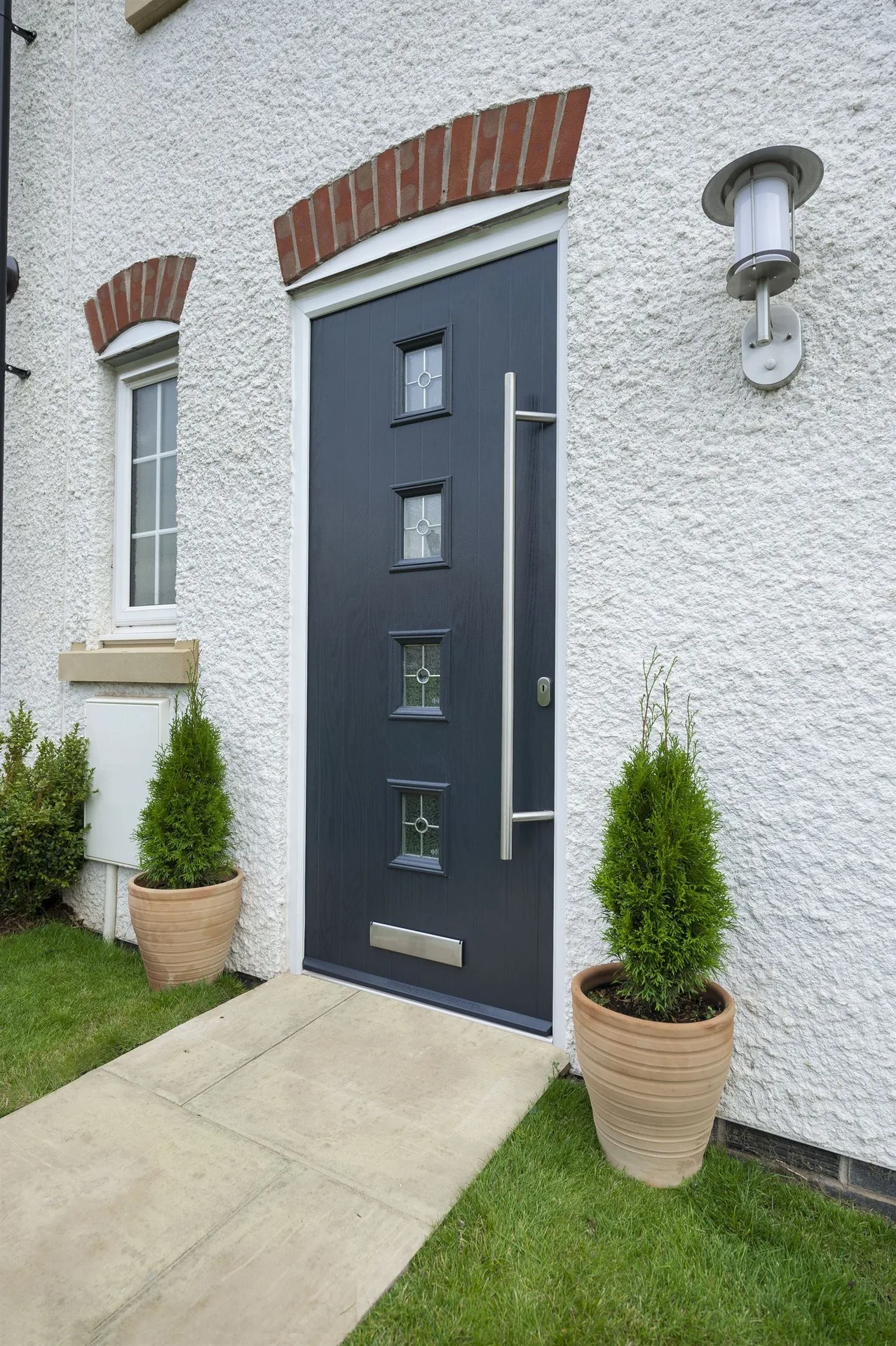
Expert advice
Cleaning the GRP skin correctly
The outer skin of a composite door is a moulded glass-reinforced plastic panel, usually finished with a textured woodgrain effect and a factory-applied colour coating designed to resist fading and hold its sheen for decades. Cleaning it is very similar to cleaning uPVC or foiled window frames: warm water and a small amount of mild, non-abrasive detergent applied with a soft cloth or sponge, rinsed thoroughly and dried, is all that is needed for routine cleaning every couple of months.
Avoid abrasive pads, cream cleansers and stiff brushes on the skin, since the moulded texture and colour coating can dull and lose definition under repeated scrubbing in the same way a powder-coated aluminium frame does. For ingrained dirt in the woodgrain texture, a soft-bristled brush used gently, rather than scrubbing pressure, will lift debris from the grooves without flattening the sheen on the raised detail.
Solvent-based cleaners, white spirit and anything containing bleach should also be kept off the skin and away from the glazing cassette seals around any decorative glass, since these can affect the coating's colour and gloss over time in much the same way they affect uPVC, and can degrade rubber gaskets around the glass on contact.
Darker colours, particularly deep blues, greens and anthracite, show water spotting and dust more readily than lighter tones simply through visual contrast, so a slightly more frequent light wipe-down, even without a full clean, tends to keep these doors looking sharper between full cleaning sessions.
Dark colours and thermal bowing in summer
It surprises many homeowners that a door can genuinely change shape, however slightly, with temperature, but this is a real and well-documented phenomenon in dark-coloured composite doors, known as thermal bowing. Dark pigments absorb considerably more solar radiation than light ones, and a black or dark blue door in direct summer sun can reach a surface temperature meaningfully higher than the air temperature around it, sometimes 20 to 30 degrees higher on a very hot, sunny day.
Because the outer GRP skin and the internal core and inner skin are different materials with slightly different thermal expansion characteristics, uneven heating across the door's thickness can cause it to bow very slightly outward or inward, typically no more than a couple of millimetres, but enough on a well-fitted door to cause a locking point or the door's edge to catch against the frame or a keep that it clears comfortably at lower temperatures.
This is usually most noticeable in the hottest part of the day and eases as the door cools in the evening, which is a useful diagnostic in itself: sticking that appears reliably in strong afternoon sun and disappears by evening is very likely thermal bowing rather than a hinge or frame fault. A degree of tolerance for this is usually built into a well-installed door and its hinge and lock adjustment, but a door that binds significantly every summer is worth having assessed, since a small amount of hinge and keep adjustment can often absorb the movement more comfortably.
This is not a reason to avoid dark colours, which remain a popular and attractive specification choice, but it is worth knowing about at the point of choosing a colour, particularly for a door on a south or west-facing elevation with no porch or canopy providing any shade during the hottest part of the day.
Hinge adjustment in three planes
Composite door hinges, usually flag hinges or adjustable butt hinges, are designed to be fine-tuned in three directions to compensate for the door's weight settling slightly over time, seasonal movement in the frame, or minor building movement in the surrounding wall. Vertical adjustment raises or lowers the door within the frame, correcting a door that has begun to drop and catch on the threshold or bottom of the frame. Lateral adjustment moves the door side to side, correcting uneven gaps between the door and frame down either side. Compression adjustment moves the door slightly closer to or further from the frame, tightening or loosening how firmly the seals compress when the door is closed.
Most adjustable hinges use a straightforward Allen key or Torx key inserted into a small adjustment point on the hinge itself, and turning it a small, measured amount, checking the effect before making further adjustment, is usually enough to correct a door that has begun to drag on the carpet, catch on the frame at one corner, or feel slightly harder to close than it used to. Large adjustments are rarely needed; a millimetre or two of vertical or lateral movement is often the entire correction required.
This is a job most homeowners can attempt cautiously themselves for a very minor issue, but a door that has dropped noticeably, is dragging heavily, or has an uneven gap visible at a glance is better assessed by a professional, since forcing an adjustment beyond the hinge's intended range can strain the hinge itself or the timber sub-frame it is fixed into.
A brief annual check, even where nothing seems wrong, catches gradual settlement before it becomes noticeable in daily use, and is a sensible five minutes to build into an annual home maintenance routine alongside gutter clearing and boiler servicing.
| Adjustment | What it corrects | Typical sign it is needed |
|---|---|---|
| Vertical | Door dropped within the frame | Dragging on threshold or carpet, catching at the bottom corner |
| Lateral | Uneven side-to-side position | Uneven gap visible down one side of the door |
| Compression | How firmly seals compress when closed | Draughts despite seals looking intact, or a door that feels loose |
Multi-point lock care and cylinder maintenance
The habit that prevents more composite door lock problems than any other is simple: lift the handle fully before turning the key, every time, without exception. Lifting the handle engages the multi-point mechanism, driving hookbolts, additional deadbolts and sometimes rollers into their keeps around the frame. Only once these are engaged should the key be turned, which throws the main deadbolt and secures the whole assembly. Turning the key first, without lifting, either fails to lock the door properly or forces the mechanism to try to move bolts that are not yet aligned with their keeps, which is one of the most common causes of a jammed or eventually broken locking gearbox.
The moving parts of the mechanism — the bolts, keeps and the gearbox behind the handle — benefit from an annual application of a graphite or PTFE-based lubricant, sprayed lightly into the keeps and along the edge of the door where the bolts protrude. Avoid oil-based household lubricants such as general purpose household oil, which attract dust and grit over time and can gum up a mechanism rather than freeing it. A light annual lubrication keeps the action smooth and reduces strain on the gearbox considerably.
The euro-cylinder, the part the key physically turns, also benefits from an annual squirt of the same graphite or PTFE lubricant directly into the keyway, worked in by turning the key several times. If your door's cylinder predates roughly 2015 and does not carry a visible anti-snap or 'snap-secure' marking, it is worth having it assessed and, if appropriate, upgraded, since older cylinder designs were the specific target of the lock-snapping burglary method that led to widespread adoption of anti-snap cylinders across the industry.
If a key ever becomes noticeably harder to turn, or the handle noticeably harder to lift, treat this as an early warning rather than something to push through repeatedly. A mechanism under strain rarely improves on its own, and a call to have it assessed while it is still functioning is considerably cheaper than a full mechanism replacement after it fails.
Threshold, seasonal seal checks and glazing cassettes
Most composite doors are fitted with a low-profile or weather-bar threshold designed to sit close to the floor for accessibility while still shedding water, and these thresholds typically include small drainage channels or weep points that let any water reaching the doorstep run away rather than pool against the bottom of the door. It is worth checking these periodically, particularly after autumn leaf fall or if an external mat sits directly over the threshold, since blocked drainage can allow water to sit against the door's bottom edge for extended periods, which is not what the door is designed to tolerate long-term.
The compression seals running around the frame, which the door presses against when closed, are rubber and age in the same way window gaskets do: gradually losing flexibility with UV exposure and years of compression. A simple seasonal check — running a hand around the closed door feeling for draughts, or checking visually for seals that look flattened, cracked or have come away from their track — twice a year, at the start of autumn and again in spring, catches wear before it becomes a noticeable draught or water ingress problem. Seals themselves are a relatively inexpensive replacement item and do not require replacing the whole door.
Where a composite door includes decorative or obscured glazing, this is typically fitted as a sealed glazing cassette held in place by a bead or gasket system rather than bonded directly into the door skin, which allows the whole unit to be removed and the glass replaced independently of the door leaf if it is ever damaged or the seal fails. If you notice misting between panes in a glazed composite door panel, this indicates the sealed unit's edge seal has failed, and the cassette can generally be replaced without needing to replace the entire door, which is worth knowing before assuming a misted panel means starting again.
Bringing these threads together, a composite door that is cleaned gently, has its hinges checked annually, is locked correctly every time, and has its seals and drainage checked twice a year will very reliably outperform an identical door given none of that attention, not because the material itself is different but because everything that makes it function mechanically has been kept in good working order throughout its life.
Common mistakes
Turning the key before fully lifting the handle
Always lift the handle completely first to engage the multi-point bolts, then turn the key. Forcing the key without lifting strains the gearbox and is a leading cause of lock failure.
Cleaning the GRP skin with an abrasive pad or solvent cleaner
Use warm water and a mild, non-abrasive detergent with a soft cloth. Abrasives and solvents dull the moulded woodgrain finish and colour coating.
Assuming summer sticking on a dark door means the door is faulty
Check whether it eases by evening — this points to thermal bowing rather than a defect, though persistent sticking is still worth a hinge assessment.
Lubricating the lock or cylinder with household oil
Use a graphite or PTFE-based lubricant instead. Oil attracts dust and grit, which can gum up the mechanism over time rather than freeing it.
Letting an external mat or debris block the threshold drainage
Keep drainage channels and weep points clear so water runs away from the threshold rather than pooling against the bottom of the door.
Frequently asked questions
Why has my dark composite door started sticking in summer only?+
This is almost always thermal bowing. Dark GRP skins absorb significantly more heat than light colours, and the outer skin can expand slightly faster than the timber-effect core and inner skin, causing a very slight bow that is enough to catch the frame or a locking point on hot days. It usually eases as the door cools in the evening and is worth having assessed if it happens consistently, since hinge and lock adjustment can often compensate for it.
Do I really need to lift the handle before turning the key?+
Yes, on every multi-point locking composite door. Lifting the handle drives the hookbolts, deadbolts and rollers into the keep before the key throws the main deadbolt. If you turn the key first, without lifting, you either cannot lock it at all or you strain the mechanism trying to force a bolt that is not aligned, which is one of the most common causes of avoidable lock failure.
How often should hinges and locks actually be adjusted?+
Most composite doors benefit from a hinge check roughly once a year, and more promptly if you notice the door beginning to drop, catch on the frame, or feel stiffer to lock than usual. This is a five-minute adjustment for most professionals and considerably cheaper than letting a misaligned door wear its lock mechanism prematurely.
What is a snap-secure cylinder and do I need one?+
A snap-secure, or anti-snap, cylinder is designed to sacrifice a small section of itself under attack rather than allowing the whole cylinder to snap and expose the locking mechanism, which was a well-publicised burglary method targeting older euro-cylinder locks. Most composite doors fitted in the last decade already include one, but if yours is older it is a straightforward and worthwhile upgrade.
Can I clean the GRP skin with the same products I use on uPVC?+
Broadly yes — warm water and a mild, non-abrasive detergent is right for both. Avoid abrasive pads on GRP just as you would on uPVC, since the skin has a moulded woodgrain texture and a factory sheen that scratching will dull, and avoid solvent cleaners on any foiled or laminated finish.
Why is there water pooling at the bottom of my door after rain?+
Check the threshold drainage first. Composite doors are usually fitted with a low-profile or weather-bar threshold that includes small drainage channels or weep points to let water run away rather than sit against the door. If these become blocked with debris or are covered by an external mat or step edge, water can pool and eventually affect the door's bottom edge and seals.