

Introduction
A well-specified roof lantern is one of the lowest-maintenance elements of a modern extension, largely because it has no moving parts beyond the odd opening vent. But low maintenance is not the same as no maintenance, and the parts that do need attention — drainage channels, gaskets, capping seals and the flashing junction with the roof — are all in places most homeowners never think to look.
The single most important piece of advice in this article has nothing to do with the lantern itself: never get onto the glass to clean or inspect it. Every other point in this guide assumes access is being managed safely, from outside the frame, because that is where almost all avoidable roof lantern incidents originate.
The rest of the routine is straightforward once you know what you are looking for. This guide covers how to clean the glass sensibly, what self-cleaning coatings actually do, how often to clear the drainage channels, what to check in the gaskets and capping, and how to tell a lantern fault from a roofing fault when water appears where it should not.
Quick summary
The short version
- Never walk on the glass — clean and inspect from a ladder, platform or water-fed pole outside the unit.
- Self-cleaning coatings need rain and UV to work and reduce, rather than remove, the need for manual cleaning.
- Clear drainage channels at least twice a year, more often under trees, to prevent water backing up over internal capping.
- Check gaskets and capping seals annually for hardening, shrinkage or gaps, particularly on the south-facing side.
- Internal condensation on the frame is usually a room ventilation issue, not a lantern fault.
- Water staining at the ceiling edge rather than under the glass usually points to the flashing junction, not the lantern.
Why this matters
A roof lantern is the most exposed piece of glazing on the house. It takes direct sun, driving rain, standing snow and, depending on the garden, a steady fall of leaves, pollen and bird debris that a vertical window never has to deal with. That exposure is exactly why the drainage and sealing details matter more here than almost anywhere else in the building envelope.
It is also, unlike a window, installed above an occupied room with a ceiling directly beneath it. A blocked drainage channel or a failed gasket on a wall-mounted window usually shows up as a draught or a damp patch on a windowsill. The same failure on a roof lantern can mean water tracking across a plasterboard ceiling before it ever becomes visible, because gravity does the moving for it.
The good news is that a genuinely small amount of attention, done at the right time of year and from the right side of the glass, prevents almost everything that goes wrong with a roof lantern over its lifetime. None of what follows requires specialist tools, though we would always recommend a professional for anything beyond ground or ladder-level access.
- Roof lanterns take more weather exposure than any vertical window in the house
- A leak here reaches a ceiling directly, not a windowsill, so early detection matters
- Drainage and sealing, not the glass itself, are almost always where problems start
- Access safety is the first consideration in every maintenance task described here
Expert advice
Access first: why the glass is never a working surface
Sealed double or triple glazed units used in roof lanterns are engineered to distribute load evenly across the whole pane — the wind and snow loads they are tested against are spread, not concentrated. A person's weight, by contrast, is applied through two small contact points, and even toughened outer panes can crack under that kind of point loading, especially at the edges or over an unsupported span between glazing bars.
This is why every reputable installer specifies external access equipment rather than roof access for cleaning and inspection: a ladder positioned against the surrounding roof structure, a scaffold tower for larger lanterns, or a telescopic water-fed pole system operated from ground level or a lower roof terrace, which is now the standard approach for most domestic cleaning contracts.
If your lantern sits in a position with no safe external access at all — deep within a courtyard, for instance, or surrounded by a fragile roof covering — this is worth raising with your installer or a specialist cleaning contractor before it becomes a problem, rather than being tempted to improvise access when the glass eventually needs attention.
As a general rule, if a task requires stepping onto the lantern itself, it is not a task to attempt. That includes retrieving a stray ball, clearing a blockage that looks reachable from above, or photographing a suspected leak from the roof side. All of these can be done more safely from below or from the surrounding roof structure.

What self-cleaning coatings do, and what they do not
Self-cleaning glass carries a thin transparent titanium dioxide coating on its outer face, and it works in two stages. The photocatalytic stage uses UV light to break down organic dirt — pollen, algae, exhaust residue — on the surface into loose particles. The hydrophilic stage causes rainwater to spread into a thin, even sheet across the glass, rather than beading, so that as it runs off it carries the loosened dirt with it instead of leaving streaked droplets behind.
Both stages depend on conditions the coating cannot control. A lantern in permanent shade, under a dense tree canopy, or through a run of dry weather will not self-clean effectively, because it is not getting the UV exposure or the rainfall the coating relies on. This is worth knowing before assuming a coating has failed — in many cases it is simply not being given the conditions to work.
It is also worth being clear that the coating is cosmetic in function. It does nothing for the frame, the gaskets, the drainage channels or the internal face of the glass, all of which still need the routine described in the rest of this guide. A lantern with immaculate self-cleaning glass and a blocked drainage channel is still at real risk of a leak.
For homes under heavy tree cover or close to a busy road, we generally still recommend a professional clean once or twice a year even with a self-cleaning coating fitted, purely to deal with the debris the coating cannot fully manage on its own — leaf litter, sap and heavier deposits sit on top of the coating rather than being broken down by it.
How often to clean, and what changes the answer
There is no single correct cleaning interval — it depends on pitch, aspect, tree cover and coating. A steeply pitched lantern in an open, sunny position with a self-cleaning coating may go a full year with only rainfall doing the work. A shallow-pitched lantern under overhanging trees, without a coating, will need attention every few months to prevent organic growth taking hold in standing moisture.
Pitch matters because it determines how effectively water sheds. Anything shallower than around fifteen degrees drains more slowly and holds standing water and debris longer after rain, which gives algae and general grime more time to establish. Steeper lanterns, and hip or ridge designs with a pronounced fall, clear themselves far more efficiently.
Aspect matters for a different reason: north-facing glass gets less direct sun and stays damp for longer after rain, which favours algae and green film, while south-facing glass gets more UV and dries faster but is also where dirt bakes on if it is not rinsed off promptly. Neither aspect is inherently lower maintenance — the type of build-up simply differs.
| Condition | Typical need | Reason |
|---|---|---|
| Steep pitch, open aspect, coated glass | Annual, or as needed | Rain and UV do most of the work |
| Shallow pitch, under trees, uncoated | Every 2–3 months | Slow drainage and organic debris accumulate |
| North-facing, sheltered position | Twice yearly | Slower drying favours algae and green film |
| Coastal or heavy pollution area | Twice yearly minimum | Salt residue and grime bond faster to the surface |
Gaskets, capping seals and drainage channels
The rubber gaskets that hold each pane against the glazing bar, and the capping seals that clip over the top to keep the whole assembly weathertight, are the parts of a roof lantern most likely to age visibly before anything structural does. Over ten to fifteen years, UV exposure gradually hardens and shrinks EPDM rubber, and the first sign is usually a small gap opening at a corner join or where two lengths of capping meet.
An annual visual check from outside — again, without walking on the glass — should look specifically at these junctions: the corners of each pane, the points where horizontal and vertical glazing bars intersect, and the ridge or apex where multiple bars converge. Any visible daylight through a capping join, or a gasket that has pulled away from the glass edge, is worth having assessed before the next heavy rain.
Drainage channels run along the base of each glazing bar and carry away any water that gets past the outer seal in driving rain, which is a normal and designed-for occurrence, not a fault. These channels rely on small weep holes to discharge water at the eaves, and those weep holes are exactly where leaves, moss and wind-blown grit collect and block the flow.
Clearing them is a simple task with a soft brush or a gentle jet of water from outside the frame, done at least twice a year and always after the main autumn leaf fall. A blocked channel does not usually cause an immediate leak — it causes water to sit and eventually rise high enough to breach the internal capping, which is why it is easy to miss until the damage has already started.

Flashing, upstands and reading the signs correctly
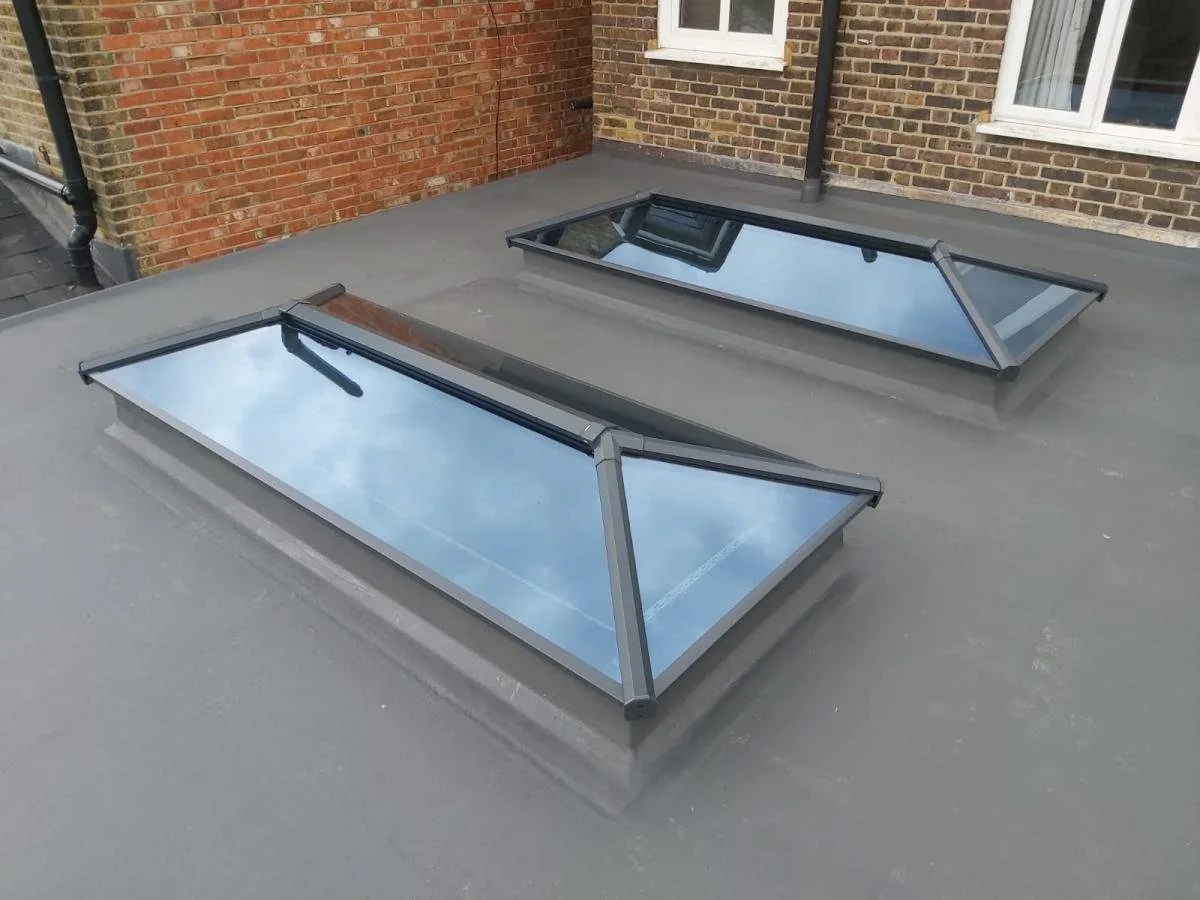
The junction where the lantern's kerb meets the surrounding flat roof is a roofing detail, not a glazing one, but it is the single most common source of leaks that get wrongly blamed on the lantern itself. Lead or membrane flashing dressed up and over the upstand can lift, crack or be dislodged by roof maintenance work carried out for an unrelated reason, and the resulting leak often shows up some distance from where the water actually enters.
The distinguishing sign is location: a leak from the lantern's own seals or drainage typically shows as staining directly beneath the glazed area, often following the line of a glazing bar. A leak from the flashing junction usually shows at the perimeter, where the ceiling meets the wall, because the water is travelling down the inside face of the upstand before it reaches a surface it can mark.
Condensation on the internal aluminium frame, as opposed to leaked water, is a different issue again and is almost always about the room below rather than the lantern above. Warm, moist air from cooking, showering or simply a well-occupied kitchen rises and meets the coldest surface it can find, which in a glazed roof is usually the aluminium bar rather than the glass itself, especially where thermal breaks are minimal. Better extraction and trickle ventilation resolve the great majority of these cases without any work to the lantern.
Where the condensation appears as persistent misting between the panes of the glass itself, rather than on the frame, that is a different matter entirely — it indicates a failed seal in the unit and no amount of ventilation will fix it. That is when to call in a glazing specialist rather than a ventilation engineer, and the sooner the better, since a failed seal only deteriorates further.
Common mistakes
Standing on the glass to clean or inspect it
Use a ladder, platform or water-fed pole from outside the unit. If there is no safe external access, arrange a specialist rather than improvising.
Assuming a self-cleaning coating means no cleaning is needed
Treat the coating as a reduction in cleaning frequency, not an elimination of it, and still schedule a professional clean once or twice a year.
Leaving drainage channels until a leak appears
Clear channels at least twice a year and always after autumn leaf fall, regardless of whether any problem is visible yet.
Blaming the lantern for a leak that originates at the flashing
Note exactly where staining first appears — centre of the ceiling versus the wall edge — and have both the glazing and roofing junction checked together.
Treating frame condensation as a product fault
Improve extraction and ventilation in the room first. Persistent misting between the panes of glass, rather than on the frame, is the genuine fault to raise with a specialist.
Frequently asked questions
Is it ever safe to walk on a roof lantern to clean it?+
No. Sealed glass units are designed to carry snow load and wind pressure evenly across their surface, not point loads from a foot or a knee. Even toughened and laminated panes can fail under localised weight, and a fall through a broken pane at roof height is a serious injury risk. All cleaning and inspection should be done from a ladder or platform positioned outside the lantern, or with a water-fed pole system from ground or roof-terrace level.
Do self-cleaning coatings mean I never need to clean the glass?+
No. The coating reduces how often manual cleaning is needed and keeps the glass looking better between cleans, but it depends on regular rainfall and reasonable UV exposure to work, and it does not touch the frame, gaskets or drainage channels at all. Most homes still benefit from a professional clean once or twice a year, particularly under trees or near flight paths.
How often should the drainage channels be cleared?+
At least twice a year as a minimum, in spring and autumn, and more often if the lantern sits under or near deciduous trees. Autumn leaf fall is the single biggest cause of blocked weep channels, and a channel that backs up during heavy rain can force water over the internal capping and onto the ceiling below.
What causes condensation on the inside of the lantern frame?+
Internal condensation on the aluminium bars is usually a sign that warm, moist household air is reaching a cold surface faster than ventilation can clear it, which is common in kitchens and bathrooms below a roof lantern. It is rarely a fault with the lantern itself. Improving extraction and trickle ventilation in the room usually resolves it; persistent pooling on the glass itself, rather than the frame, points to a failed seal and needs inspection.
How do I know if the flashing has failed rather than the lantern itself?+
Water staining that appears at the very edge of the ceiling, tracking in from the wall rather than from the centre of the glazed area, almost always originates at the upstand or flashing junction rather than the lantern's own seals. This is a roofing detail rather than a glazing one, and it is worth having both trades look at the junction together so responsibility is not passed back and forth.
Can I fit a roof lantern with a warm roof upstand retrospectively?+
In most cases yes, provided the existing opening and structural kerb are sound. A warm roof upstand insulates the vertical junction between the flat roof and the lantern, which is often the coldest point in the whole structure and a common source of both heat loss and condensation. It is a straightforward retrofit for most flat roof coverings and is worth discussing if the room below is persistently cold or prone to misting at that edge.