

Introduction
A window is not a single object. It is a frame, a sash, a sealed glass unit, a set of hinges, a locking mechanism, a run of gaskets and a drainage path, all working together. When something goes wrong, it is usually one of those parts rather than all of them — and the price difference between fixing one part and replacing the whole window is considerable.
The difficulty for a homeowner is that quite different faults produce similar-looking symptoms. Water on the cill might be condensation, a blocked drainage slot or a failed external seal. A stiff window might need lubrication, adjustment or a new friction stay. Each has a different remedy and a different cost, and the diagnosis matters more than the repair.
This article works through the faults we are called out to most often, what each one actually indicates, what can reasonably be put right, and how to judge whether repair or replacement is the better use of your money. In a fair number of cases the honest answer is that the windows have years left in them and only need a service.
Quick summary
The short version
- Misting between the panes means a failed sealed unit — replace the glass, not usually the window.
- Condensation on the room-side face is a ventilation and humidity issue, not a glazing fault.
- Stiffness and draughts most often come from worn or dirty hardware and compressed gaskets, all of which are replaceable.
- Water at the cill is more often a blocked drainage slot or failed mastic than a failed window.
- Hardware is the shortest-lived component; expect attention somewhere around year ten to fifteen.
- Replace when frames have distorted or decayed structurally, or when several faults coincide in old, thermally poor units.
Why this matters
The glazing industry has a commercial incentive to answer every fault with a quotation for new windows. Sometimes that is genuinely the right advice. Often it is not, and a homeowner spends several thousand pounds resolving a problem that a hundred-pound component and an hour of labour would have fixed just as permanently.
There is also a timing argument. A small fault left alone rarely stays small. A blocked drainage slot leads to standing water in the frame chamber, which eventually finds the internal cill and the plaster below it. A slightly dropped sash puts the locking cams out of alignment, which strains the gearbox until it fails. Catching these early is inexpensive; catching them late is not.
Finally, knowing what is wrong changes the conversation you have with an installer. A homeowner who says the sealed unit has misted and asks for a glass-only replacement gets a different quotation from one who says the windows have gone and asks what a new set costs.
- Sealed unit replacement: a fraction of the cost of a new window, same frame retained
- Hardware replacement: handles, hinges and gearboxes are almost always available as parts
- Gasket and seal renewal: restores weather-tightness without touching the frame
- Full replacement: justified by structural frame failure or genuinely obsolete glazing
Expert advice
Misting and moisture between the panes
A sealed unit is two or three panes of glass separated by a spacer bar, with the perimeter sealed twice — a primary butyl seal against gas loss and a secondary structural seal. Inside the spacer sits a desiccant that absorbs the small amount of moisture present when the unit is made. When the perimeter seal fails, outside air enters, the desiccant saturates, and moisture begins to condense inside the cavity where you cannot reach it.
The visual signature is unmistakable: a haze or streaking that appears on cold or humid days, sometimes clearing in dry weather, gradually becoming permanent. Over time a chalky tide mark builds up on the inner faces. By then the argon fill has long gone and the unit is performing closer to single glazing than double.
The repair is to replace the sealed unit while keeping the existing frame and sash, provided the frame is sound. A glazier measures the unit, orders the replacement to match the original specification — and this is the moment to consider whether to upgrade the glass to a better low-emissivity coating, an acoustic laminate or a warm-edge spacer.
Be sceptical of services that offer to drill the unit, dry it out and fit vents. The mist may clear temporarily, but the seal is still failed, the cavity is now permanently open to outside air, and the gas fill is not coming back. It treats the symptom and leaves the window performing badly.
Draughts, whistling and cold edges
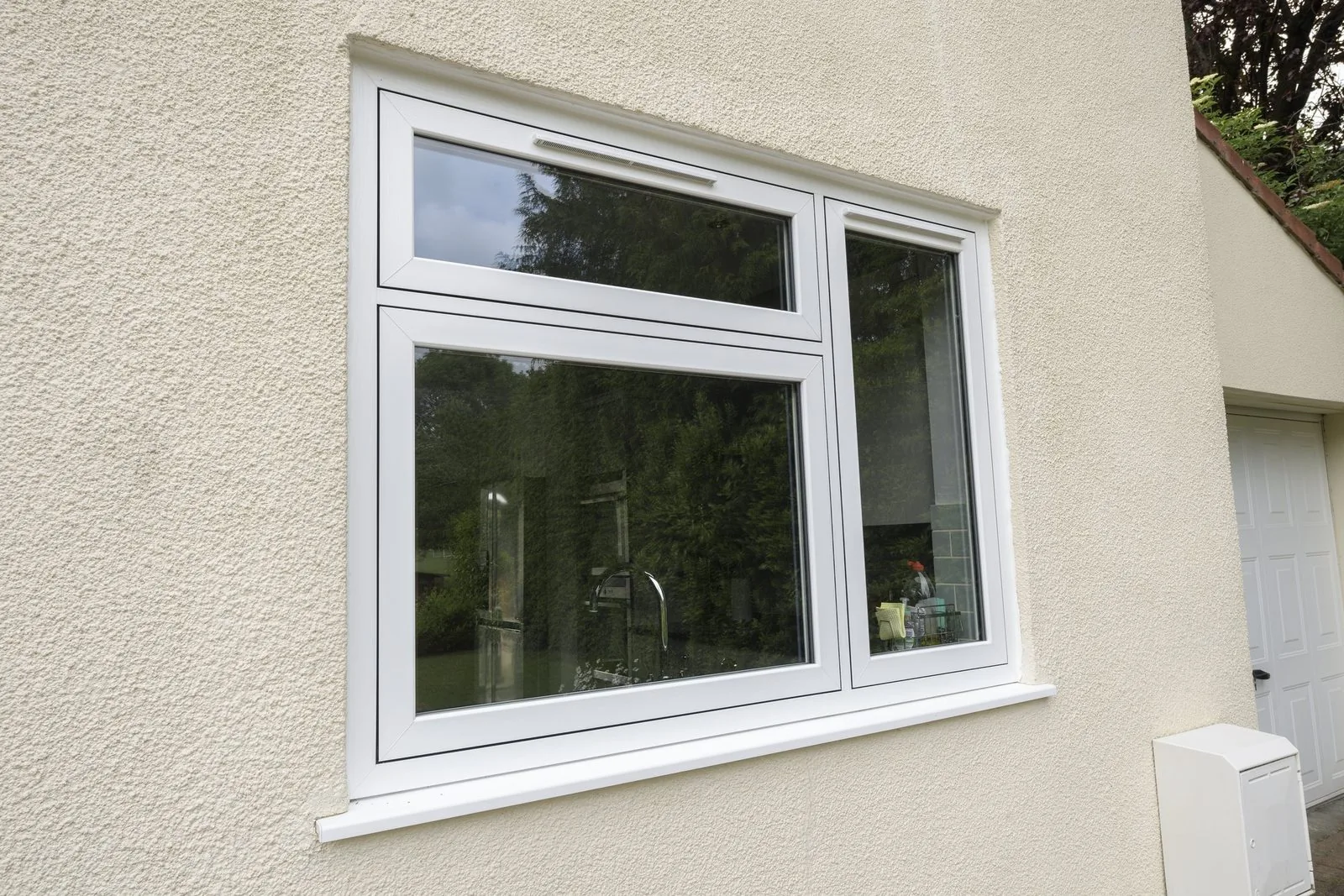
Draughts in a relatively modern window almost always come from the gasket rather than the frame. The compression seal that runs around the sash flattens over years of closing, and eventually stops making continuous contact. Rubber also hardens with UV exposure, particularly on south-facing elevations, losing the elasticity it needs to recover after each closing.
The test is straightforward. Close the window on a strip of paper and try to pull it out. If it slides freely, the seal is not compressing at that point. Repeat at intervals around the perimeter — you will often find the failure is concentrated at the top corners or along the hinge side, where the sash sits marginally proud.
Gaskets are replaceable. Most systems use a push-fit profile that can be pulled out and renewed in a continuous run, and the material cost is modest. Where the paper test fails uniformly rather than at points, the more likely cause is a sash that needs adjusting back into compression at the hinges and keeps, which is an adjustment rather than a parts job.
Whistling is a different symptom with a different cause. It is usually air passing through a trickle vent that has lost its baffle, or through a drainage slot whose external cover has come off. Both are cheap to put right, and neither should be resolved by sealing the opening up — those paths exist for a reason.
| Symptom | Most likely cause | Typical remedy |
|---|---|---|
| Localised draught at one corner | Sash out of compression at hinge or keep | Adjustment |
| Draught around whole perimeter | Hardened or flattened gasket | Gasket renewal |
| Whistling in wind | Missing trickle vent baffle or drainage cover | Component replacement |
| Cold radiating from glass edge | Aluminium spacer bar cold bridging | Sealed unit upgrade to warm edge |
Stiff operation, dropped sashes and misalignment
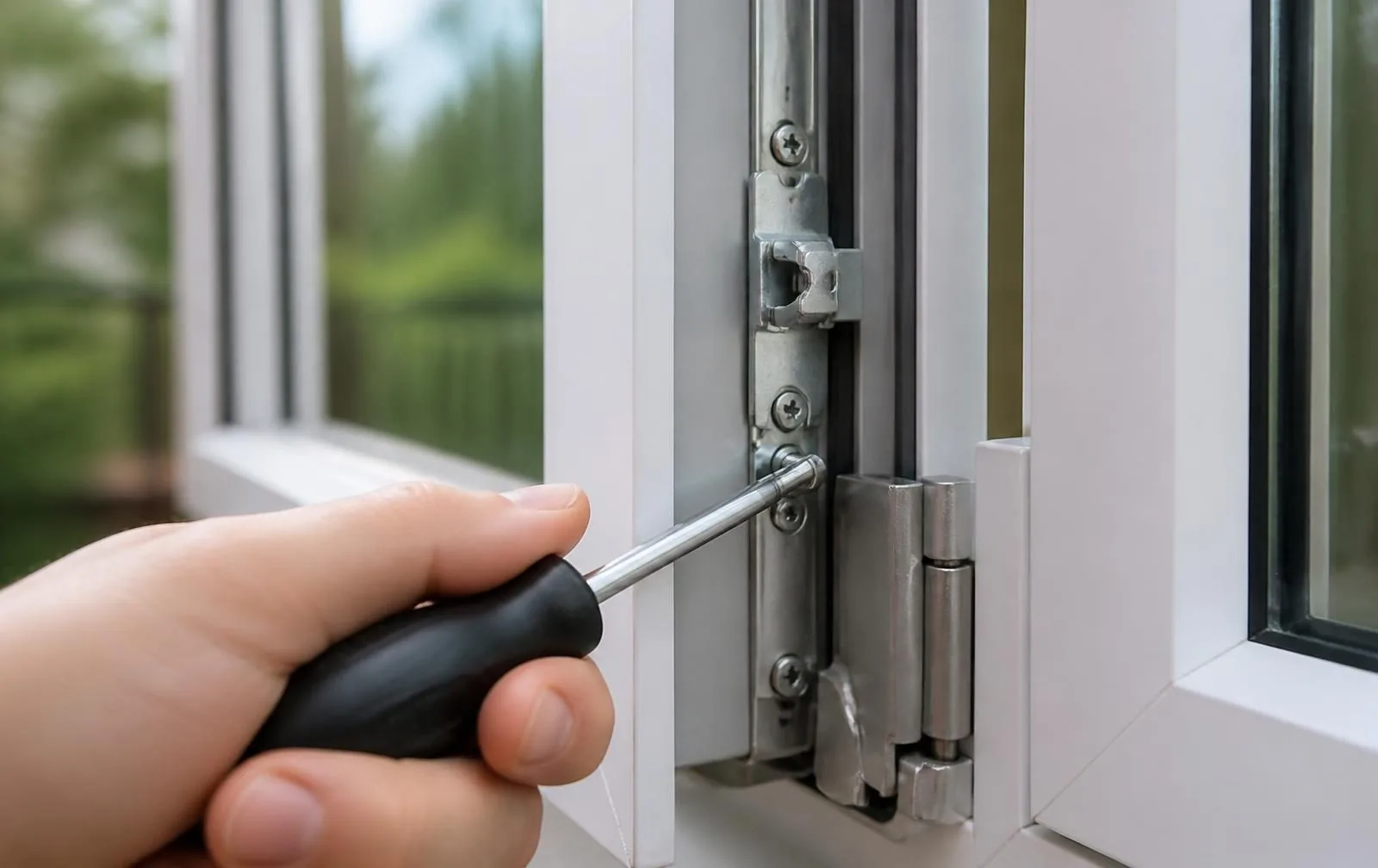
Friction stays — the scissor hinges on a side or top-hung casement — carry the full weight of the sash on a small stainless steel track. Grit works into that track, the sliding shoe binds, and the window becomes progressively harder to push open. Cleaning the track and applying a light machine oil resolves a large proportion of stiff-window callouts.
Where lubrication makes no difference, look at geometry. Stand outside and check the margin between sash and frame along all four edges. A consistent gap means alignment is fine. A gap that tapers — wide at the top of the opening side, tight at the bottom — means the sash has dropped, and the hinge is either worn or has begun to deflect under load. Large or triple-glazed sashes are the usual candidates because of the weight.
A dropped sash matters beyond the inconvenience. Multi-point locking relies on cams meeting keeps at precise positions. Once the sash sits a few millimetres low, the cams strike the keep edges instead of rolling into them, and every operation of the handle puts strain on the gearing. Left long enough, the gearbox fails, and that is a more involved repair than the hinge would have been.
In timber windows, seasonal movement produces the same symptoms without any hardware fault. A window that binds only in humid summer weather and operates freely in winter is swelling, not failing. Easing the binding edge slightly and refinishing the exposed timber is the correct response.
Handles, locks and mechanisms that no longer engage
Handles fail in two ways. The spindle wears in its housing so the handle turns loosely without driving the gearing, or the internal spring gives up so the handle no longer returns to horizontal. Both are handle replacements, and both are straightforward provided you match the spindle length and the backset to the existing mechanism.
Locking gearboxes are more consequential. The symptom is a handle that turns but meets no resistance, or that stops part-way through its travel. This is usually the end of a long period of misalignment strain rather than a sudden event. The gearbox is replaceable, but it is a specific part matched to the espagnolette in that sash, so it needs identifying rather than guessing.
Cylinder problems in doors deserve their own note. A cylinder that has become stiff should be treated with a dry PTFE or graphite-based lubricant, never an oil-based spray — oil attracts dust and eventually gums the pin chambers solid. If a key has begun to catch, that is the moment to act rather than after it snaps in the lock.
One habit is worth establishing across the household: on any multi-point locked window or door, lift the handle fully before turning the key. Locking against unengaged cams is the single most common cause of premature gearbox failure we see.
Deciding between a repair and a replacement
The test we apply is simple: is the frame sound, square and weather-tight? If it is, virtually everything else is a component and a component can be changed. Sealed units, gaskets, friction stays, handles, gearboxes, trickle vents and cill end caps are all serviceable parts, and a good repair extends the life of the window by many years for a small fraction of replacement cost.
Replacement becomes the better decision when the frame itself has gone. In uPVC, that means corners that have opened, profiles that have distorted with heat, or reinforcement that has corroded. In timber, it means decay reaching structural sections rather than surface paint failure. In aluminium, it usually means an early system with no thermal break, where no amount of component work will fix the cold bridge.
The other trigger is accumulation. One failed sealed unit is a glass job. Six failed units across a house, alongside worn hardware and hardened gaskets, is a set of windows reaching the end of its service life, and the sum of the repairs starts to approach the cost of replacement without any of the thermal improvement.
Where a property is being reglazed for performance reasons rather than fault, be honest with yourself about the return. Replacing sound fifteen-year-old double glazing purely for a modest U-value improvement rarely justifies itself. Replacing it because the frames have failed, and taking the opportunity to improve the specification, is a very different proposition.
Common mistakes
Replacing whole windows because the glass has misted
Ask for a sealed-unit-only quotation first. If the frames are sound, the glass can be changed in situ — and it is the moment to upgrade the coating or spacer at little extra cost.
Treating internal condensation as a window fault
Address humidity and ventilation before spending anything on glazing. Extract at source, keep trickle vents open, and check whether the problem follows drying laundry or long showers.
Forcing a stiff or misaligned window
Stop and diagnose. Forcing a sash that is out of alignment transfers the load into the locking gearing and turns a hinge adjustment into a gearbox replacement.
Using general-purpose penetrating spray on cylinders and stays
Use light machine oil on friction stays and a dry PTFE or graphite lubricant in cylinders. Oil-based sprays in a lock attract dust and eventually seize the mechanism.
Sealing up drainage slots and trickle vents to stop draughts
Both exist to manage water and air deliberately. Blocking them causes standing water in the frame and raises internal humidity — creating two problems in place of one.
Frequently asked questions
My double glazing has misted between the panes. Can it be repaired?+
Not meaningfully. Misting means the perimeter seal of the sealed unit has failed and moisture has entered the cavity, which also means the argon fill has gone. Drilling and drying the unit is sometimes offered but it does not restore the seal or the gas, so performance stays poor. Replacing the sealed unit alone — keeping the existing frame — is usually the sensible fix and costs far less than a new window.
Why has my window suddenly become stiff to open?+
Usually one of three things: dirt and grit in the friction stay, a hinge that has begun to sag under the weight of the sash, or seasonal movement in a timber frame. Cleaning and lubricating the stay resolves a good proportion of cases. If the sash is visibly out of square in the frame, the problem is alignment, not lubrication, and forcing it will damage the gearing.
There is condensation on the inside of my windows every morning. Are they faulty?+
Almost certainly not. Internal condensation is a humidity and ventilation issue, not a glazing fault. Warm moist air meets the coldest surface in the room and reaches dew point. Increasing background ventilation, using extract fans properly and keeping trickle vents open resolves most cases. A genuinely faulty window would show misting between the panes, not on the room-side face.
Water is appearing on the inside cill. Where is it coming from?+
Check the drainage slots on the outer face of the frame first — if they are blocked with dust, paint or spider webs, water sitting in the frame chamber will find its way inwards. After that, look at the external sealant bead, the cill end caps and the pointing above the opening. Genuine failure of the window itself is rarer than a blocked drain or a failed mastic joint.
When is a repair the better decision than replacement?+
When the frames are sound, square and weather-tight, and the fault is confined to a component — a handle, a hinge, a lock gearbox, a sealed unit or a gasket. Those parts are almost all replaceable. Replacement makes more sense when frames have distorted, timber has decayed structurally, several units have failed at once, or the windows predate proper thermal glazing altogether.
How long should modern windows last before problems appear?+
Quality uPVC and aluminium frames should run for twenty-five years or more. Sealed units typically carry a ten to twenty year guarantee against misting, and hardware — handles, hinges, lock gearboxes — is the shortest-lived element, often needing attention somewhere between year ten and year fifteen. Hardware wearing out is normal maintenance, not a sign the windows have failed.
Related products